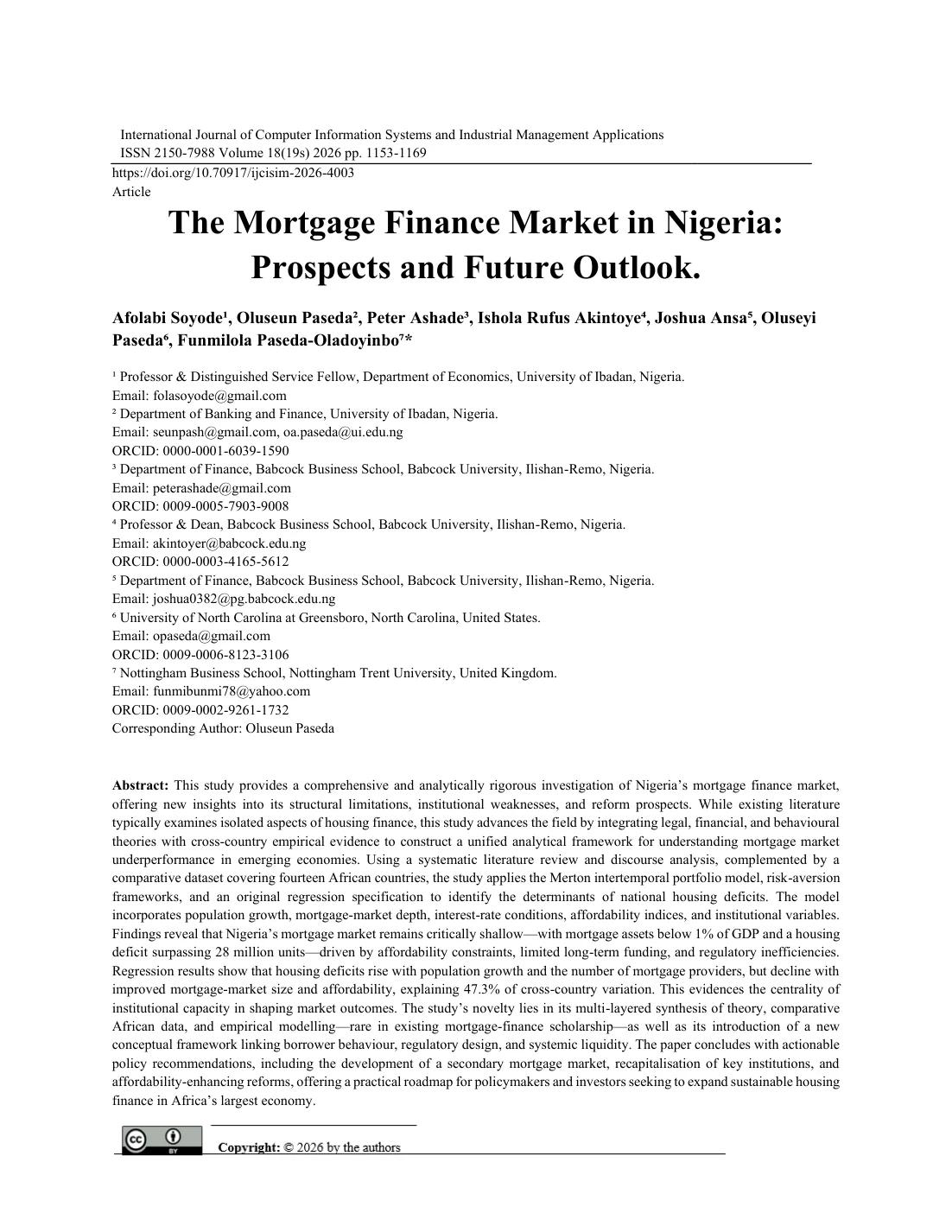
This study provides a comprehensive and analytically rigorous investigation of Nigeria’s mortgage finance market, offering new insights into its structural limitations, institutional weaknesses, and reform prospects. While existing literature typically examines isolated aspects of housing finance, this study advances the field by integrating legal, financial, and behavioural theories with cross-country empirical evidence to construct a unified analytical framework for understanding mortgage market underperformance in emerging economies. Using a systematic literature review and discourse analysis, complemented by a comparative dataset covering fourteen African countries, the study applies the Merton intertemporal portfolio model, risk-aversion frameworks, and an original regression specification to identify the determinants of national housing deficits. The model incorporates population growth, mortgage-market depth, interest-rate conditions, affordability indices, and institutional variables. Findings reveal that Nigeria’s mortgage market remains critically shallow—with mortgage assets below 1% of GDP and a housing deficit surpassing 28 million units—driven by affordability constraints, limited long-term funding, and regulatory inefficiencies. Regression results show that housing deficits rise with population growth and the number of mortgage providers, but decline with improved mortgage-market size and affordability, explaining 47.3% of cross-country variation. This evidences the centrality of institutional capacity in shaping market outcomes. The study’s novelty lies in its multi-layered synthesis of theory, comparative African data, and empirical modelling—rare in existing mortgage-finance scholarship—as well as its introduction of a new conceptual framework linking borrower behaviour, regulatory design, and systemic liquidity. The paper concludes with actionable policy recommendations, including the development of a secondary mortgage market, recapitalisation of key institutions, and affordability-enhancing reforms, offering a practical roadmap for policymakers and investors seeking to expand sustainable housing finance in Africa’s largest economy.
Journal article · 2026
The Mortgage Finance Market in Nigeria: Prospects and Future Outlook
International Journal of Computer Information Systems and Industrial Management Applications · Volume 18(19s), pp. 1153–1169 · ISSN 2150-7988
Read the complete paper
All 17 pages are below. Enlarge a page or open its text version.
Page 1 of 17
Read page 1 as text
Refer to the original page for equations and table layout.
International Journal of Computer Information Systems and Industrial Management Applications ISSN 2150-7988 Volume 18(19s) 2026 pp. 1153-1169 https://doi.org/10.70917/ijcisim-2026-4003 Article The Mortgage Finance Market in Nigeria: Prospects and Future Outlook. Afolabi Soyode¹, Oluseun Paseda², Peter Ashade³, Ishola Rufus Akintoye⁴, Joshua Ansa⁵, Oluseyi Paseda⁶, Funmilola Paseda-Oladoyinbo⁷* ¹ Professor & Distinguished Service Fellow, Department of Economics, University of Ibadan, Nigeria. Email: folasoyode@gmail.com ² Department of Banking and Finance, University of Ibadan, Nigeria. Email: seunpash@gmail.com, oa.paseda@ui.edu.ng ORCID: 0000-0001-6039-1590 ³ Department of Finance, Babcock Business School, Babcock University, Ilishan-Remo, Nigeria. Email: peterashade@gmail.com ORCID: 0009-0005-7903-9008 ⁴ Professor & Dean, Babcock Business School, Babcock University, Ilishan-Remo, Nigeria. Email: akintoyer@babcock.edu.ng ORCID: 0000-0003-4165-5612 ⁵ Department of Finance, Babcock Business School, Babcock University, Ilishan-Remo, Nigeria. Email: joshua0382@pg.babcock.edu.ng ⁶ University of North Carolina at Greensboro, North Carolina, United States. Email: opaseda@gmail.com ORCID: 0009-0006-8123-3106 ⁷ Nottingham Business School, Nottingham Trent University, United Kingdom. Email: funmibunmi78@yahoo.com ORCID: 0009-0002-9261-1732 Corresponding Author: Oluseun Paseda Abstract: This study provides a comprehensive and analytically rigorous investigation of Nigeria’s mortgage finance market, offering new insights into its structural limitations, institutional weaknesses, and reform prospects. While existing literature typically examines isolated aspects of housing finance, this study advances the field by integrating legal, financial, and behavioural theories with cross-country empirical evidence to construct a unified analytical framework for understanding mortgage market underperformance in emerging economies. Using a systematic literature review and discourse analysis, complemented by a comparative dataset covering fourteen African countries, the study applies the Merton intertemporal portfolio model, risk-aversion frameworks, and an original regression specification to identify the determinants of national housing deficits. The model incorporates population growth, mortgage-market depth, interest-rate conditions, affordability indices, and institutional variables. Findings reveal that Nigeria’s mortgage market remains critically shallow—with mortgage assets below 1% of GDP and a housing deficit surpassing 28 million units—driven by affordability constraints, limited long-term funding, and regulatory inefficiencies. Regression results show that housing deficits rise with population growth and the number of mortgage providers, but decline with improved mortgage-market size and affordability, explaining 47.3% of cross-country variation. This evidences the centrality of institutional capacity in shaping market outcomes. The study’s novelty lies in its multi-layered synthesis of theory, comparative African data, and empirical modelling—rare in existing mortgage-finance scholarship—as well as its introduction of a new conceptual framework linking borrower behaviour, regulatory design, and systemic liquidity. The paper concludes with actionable policy recommendations, including the development of a secondary mortgage market, recapitalisation of key institutions, and affordability-enhancing reforms, offering a practical roadmap for policymakers and investors seeking to expand sustainable housing finance in Africa’s largest economy.
Page 2 of 17
Read page 2 as text
Refer to the original page for equations and table layout.
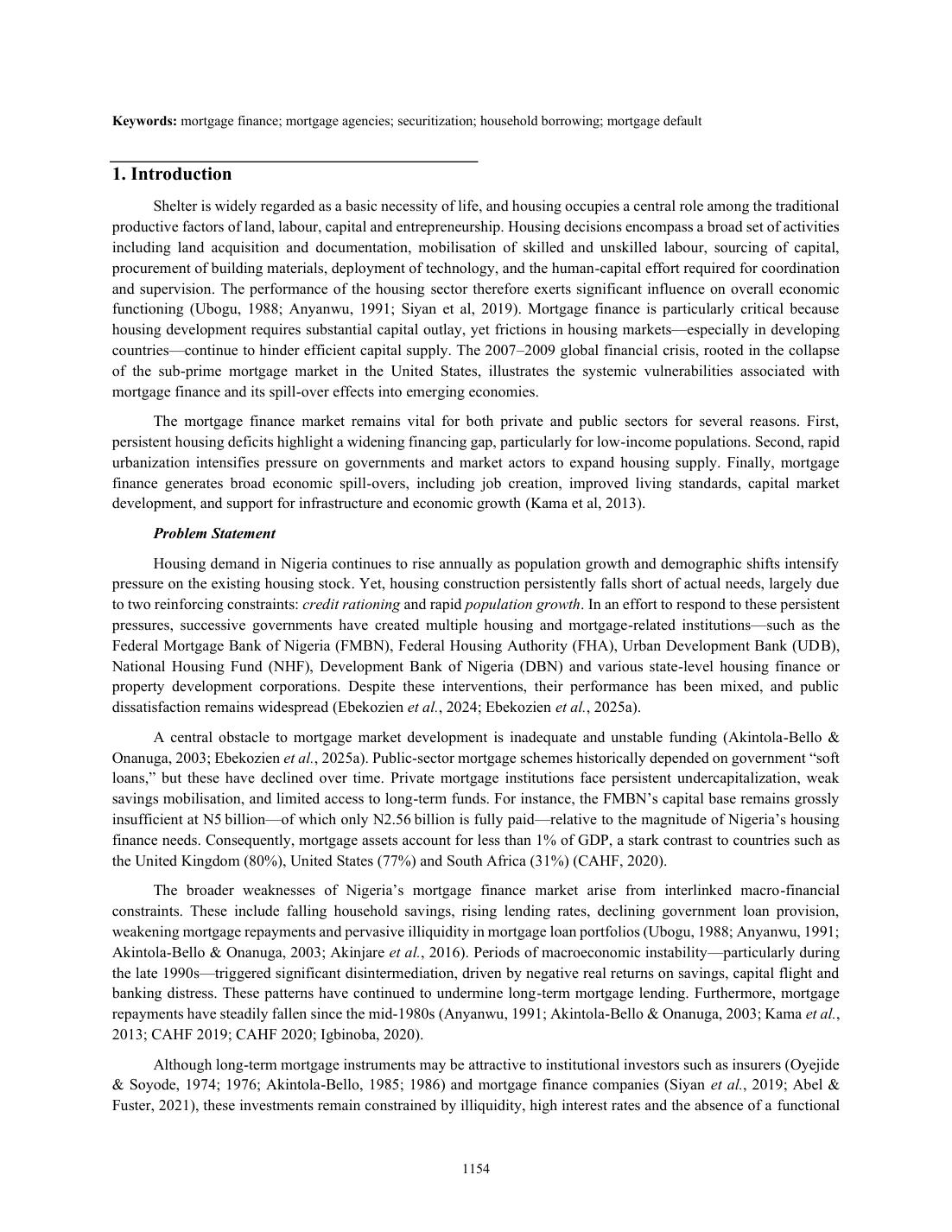
Keywords: mortgage finance; mortgage agencies; securitization; household borrowing; mortgage default 1. Introduction Shelter is widely regarded as a basic necessity of life, and housing occupies a central role among the traditional productive factors of land, labour, capital and entrepreneurship. Housing decisions encompass a broad set of activities including land acquisition and documentation, mobilisation of skilled and unskilled labour, sourcing of capital, procurement of building materials, deployment of technology, and the human-capital effort required for coordination and supervision. The performance of the housing sector therefore exerts significant influence on overall economic functioning (Ubogu, 1988; Anyanwu, 1991; Siyan et al, 2019). Mortgage finance is particularly critical because housing development requires substantial capital outlay, yet frictions in housing markets—especially in developing countries—continue to hinder efficient capital supply. The 2007–2009 global financial crisis, rooted in the collapse of the sub-prime mortgage market in the United States, illustrates the systemic vulnerabilities associated with mortgage finance and its spill-over effects into emerging economies. The mortgage finance market remains vital for both private and public sectors for several reasons. First, persistent housing deficits highlight a widening financing gap, particularly for low-income populations. Second, rapid urbanization intensifies pressure on governments and market actors to expand housing supply. Finally, mortgage finance generates broad economic spill-overs, including job creation, improved living standards, capital market development, and support for infrastructure and economic growth (Kama et al, 2013). Problem Statement Housing demand in Nigeria continues to rise annually as population growth and demographic shifts intensify pressure on the existing housing stock. Yet, housing construction persistently falls short of actual needs, largely due to two reinforcing constraints: credit rationing and rapid population growth. In an effort to respond to these persistent pressures, successive governments have created multiple housing and mortgage-related institutions—such as the Federal Mortgage Bank of Nigeria (FMBN), Federal Housing Authority (FHA), Urban Development Bank (UDB), National Housing Fund (NHF), Development Bank of Nigeria (DBN) and various state-level housing finance or property development corporations. Despite these interventions, their performance has been mixed, and public dissatisfaction remains widespread (Ebekozien et al., 2024; Ebekozien et al., 2025a). A central obstacle to mortgage market development is inadequate and unstable funding (Akintola-Bello & Onanuga, 2003; Ebekozien et al., 2025a). Public-sector mortgage schemes historically depended on government “soft loans,” but these have declined over time. Private mortgage institutions face persistent undercapitalization, weak savings mobilisation, and limited access to long-term funds. For instance, the FMBN’s capital base remains grossly insufficient at N5 billion—of which only N2.56 billion is fully paid—relative to the magnitude of Nigeria’s housing finance needs. Consequently, mortgage assets account for less than 1% of GDP, a stark contrast to countries such as the United Kingdom (80%), United States (77%) and South Africa (31%) (CAHF, 2020). The broader weaknesses of Nigeria’s mortgage finance market arise from interlinked macro-financial constraints. These include falling household savings, rising lending rates, declining government loan provision, weakening mortgage repayments and pervasive illiquidity in mortgage loan portfolios (Ubogu, 1988; Anyanwu, 1991; Akintola-Bello & Onanuga, 2003; Akinjare et al., 2016). Periods of macroeconomic instability—particularly during the late 1990s—triggered significant disintermediation, driven by negative real returns on savings, capital flight and banking distress. These patterns have continued to undermine long-term mortgage lending. Furthermore, mortgage repayments have steadily fallen since the mid-1980s (Anyanwu, 1991; Akintola-Bello & Onanuga, 2003; Kama et al., 2013; CAHF 2019; CAHF 2020; Igbinoba, 2020). Although long-term mortgage instruments may be attractive to institutional investors such as insurers (Oyejide & Soyode, 1974; 1976; Akintola-Bello, 1985; 1986) and mortgage finance companies (Siyan et al., 2019; Abel & Fuster, 2021), these investments remain constrained by illiquidity, high interest rates and the absence of a functional 1154
Page 3 of 17
Read page 3 as text
Refer to the original page for equations and table layout.
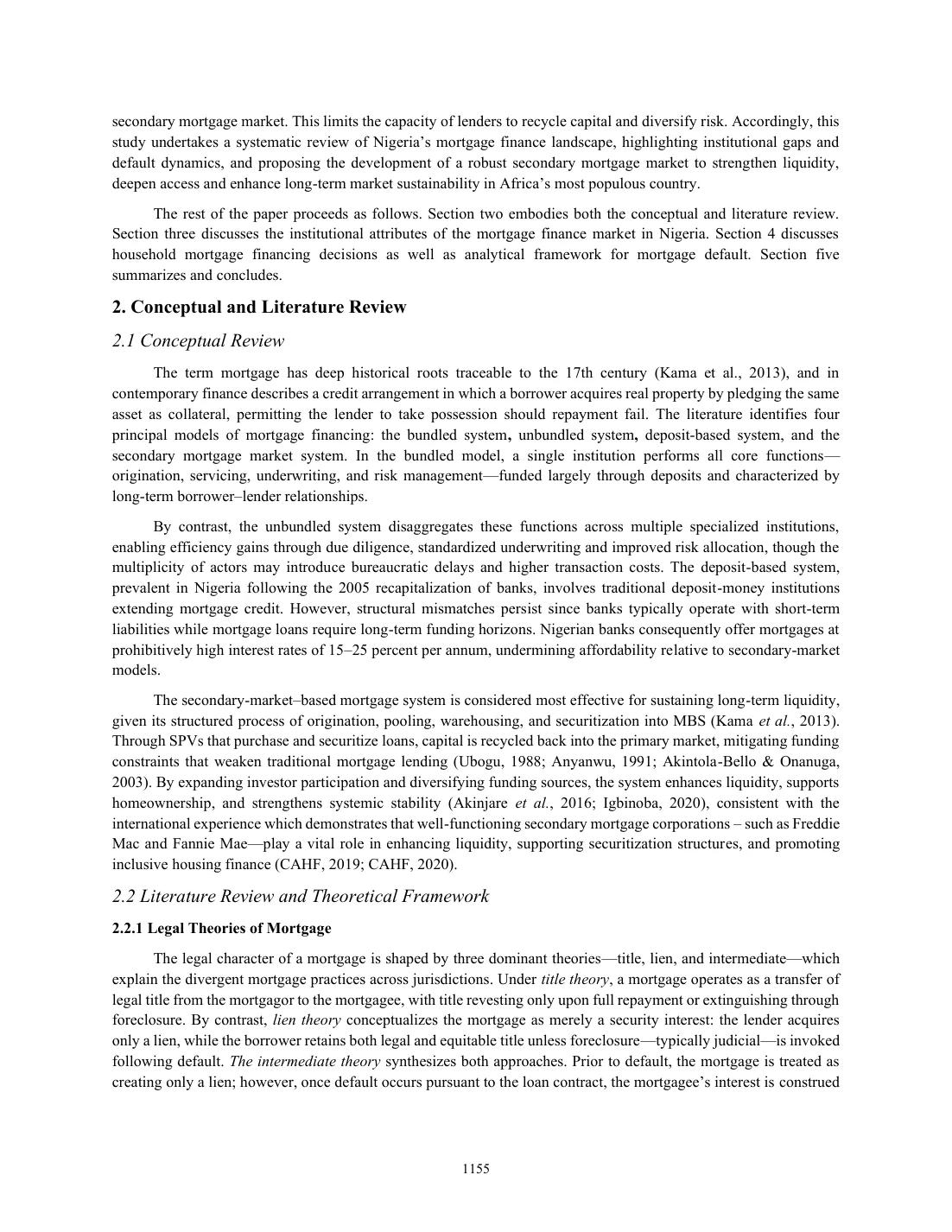
secondary mortgage market. This limits the capacity of lenders to recycle capital and diversify risk. Accordingly, this study undertakes a systematic review of Nigeria’s mortgage finance landscape, highlighting institutional gaps and default dynamics, and proposing the development of a robust secondary mortgage market to strengthen liquidity, deepen access and enhance long-term market sustainability in Africa’s most populous country. The rest of the paper proceeds as follows. Section two embodies both the conceptual and literature review. Section three discusses the institutional attributes of the mortgage finance market in Nigeria. Section 4 discusses household mortgage financing decisions as well as analytical framework for mortgage default. Section five summarizes and concludes. 2. Conceptual and Literature Review 2.1 Conceptual Review The term mortgage has deep historical roots traceable to the 17th century (Kama et al., 2013), and in contemporary finance describes a credit arrangement in which a borrower acquires real property by pledging the same asset as collateral, permitting the lender to take possession should repayment fail. The literature identifies four principal models of mortgage financing: the bundled system, unbundled system, deposit-based system, and the secondary mortgage market system. In the bundled model, a single institution performs all core functions— origination, servicing, underwriting, and risk management—funded largely through deposits and characterized by long-term borrower–lender relationships. By contrast, the unbundled system disaggregates these functions across multiple specialized institutions, enabling efficiency gains through due diligence, standardized underwriting and improved risk allocation, though the multiplicity of actors may introduce bureaucratic delays and higher transaction costs. The deposit-based system, prevalent in Nigeria following the 2005 recapitalization of banks, involves traditional deposit-money institutions extending mortgage credit. However, structural mismatches persist since banks typically operate with short-term liabilities while mortgage loans require long-term funding horizons. Nigerian banks consequently offer mortgages at prohibitively high interest rates of 15–25 percent per annum, undermining affordability relative to secondary-market models. The secondary-market–based mortgage system is considered most effective for sustaining long-term liquidity, given its structured process of origination, pooling, warehousing, and securitization into MBS (Kama et al., 2013). Through SPVs that purchase and securitize loans, capital is recycled back into the primary market, mitigating funding constraints that weaken traditional mortgage lending (Ubogu, 1988; Anyanwu, 1991; Akintola-Bello & Onanuga, 2003). By expanding investor participation and diversifying funding sources, the system enhances liquidity, supports homeownership, and strengthens systemic stability (Akinjare et al., 2016; Igbinoba, 2020), consistent with the international experience which demonstrates that well-functioning secondary mortgage corporations – such as Freddie Mac and Fannie Mae—play a vital role in enhancing liquidity, supporting securitization structures, and promoting inclusive housing finance (CAHF, 2019; CAHF, 2020). 2.2 Literature Review and Theoretical Framework 2.2.1 Legal Theories of Mortgage The legal character of a mortgage is shaped by three dominant theories—title, lien, and intermediate—which explain the divergent mortgage practices across jurisdictions. Under title theory, a mortgage operates as a transfer of legal title from the mortgagor to the mortgagee, with title revesting only upon full repayment or extinguishing through foreclosure. By contrast, lien theory conceptualizes the mortgage as merely a security interest: the lender acquires only a lien, while the borrower retains both legal and equitable title unless foreclosure—typically judicial—is invoked following default. The intermediate theory synthesizes both approaches. Prior to default, the mortgage is treated as creating only a lien; however, once default occurs pursuant to the loan contract, the mortgagee’s interest is construed 1155
Page 4 of 17
Read page 4 as text
Refer to the original page for equations and table layout.
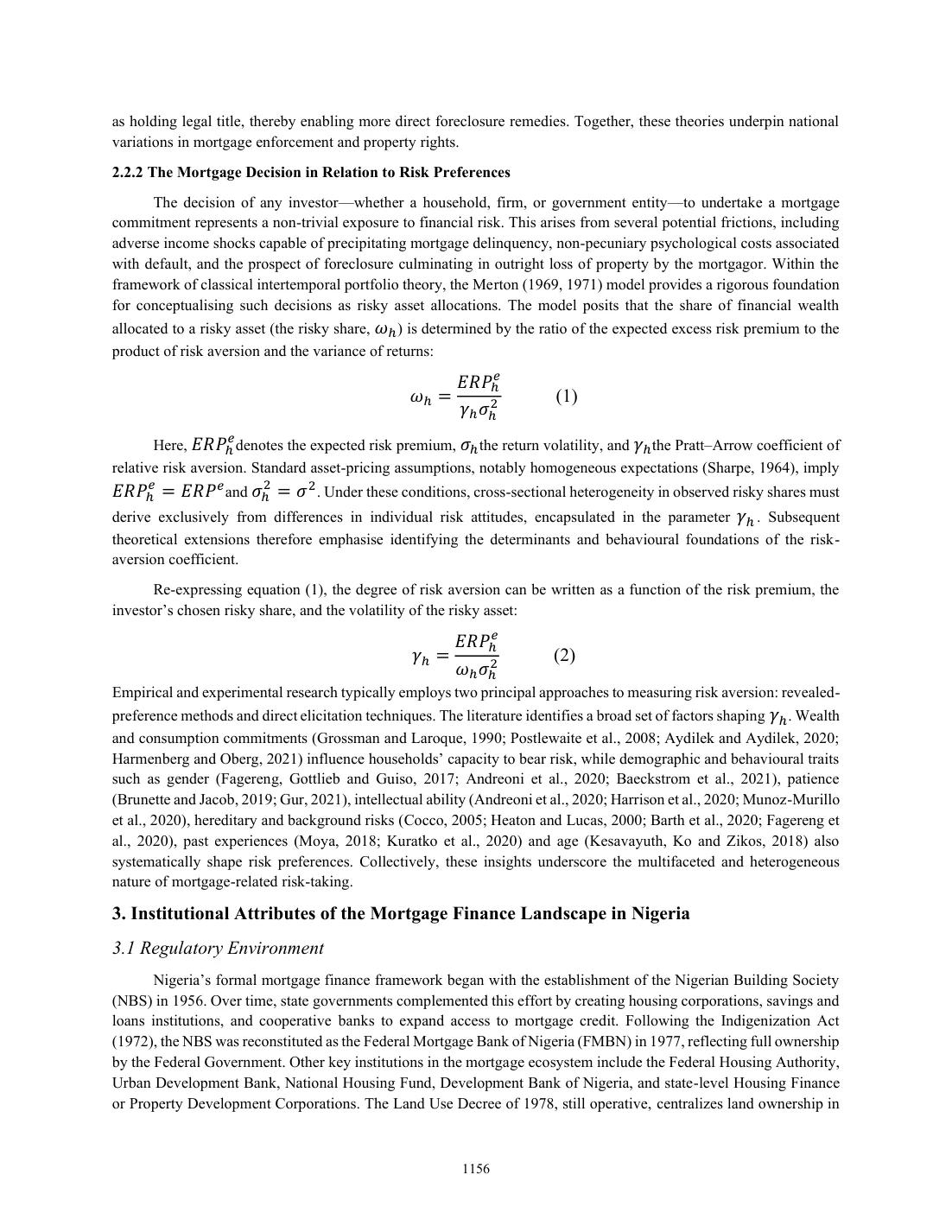
as holding legal title, thereby enabling more direct foreclosure remedies. Together, these theories underpin national variations in mortgage enforcement and property rights. 2.2.2 The Mortgage Decision in Relation to Risk Preferences The decision of any investor—whether a household, firm, or government entity—to undertake a mortgage commitment represents a non-trivial exposure to financial risk. This arises from several potential frictions, including adverse income shocks capable of precipitating mortgage delinquency, non-pecuniary psychological costs associated with default, and the prospect of foreclosure culminating in outright loss of property by the mortgagor. Within the framework of classical intertemporal portfolio theory, the Merton (1969, 1971) model provides a rigorous foundation for conceptualising such decisions as risky asset allocations. The model posits that the share of financial wealth allocated to a risky asset (the risky share, 𝜔ℎ) is determined by the ratio of the expected excess risk premium to the product of risk aversion and the variance of returns: 𝐸𝑅𝑃ℎ𝑒 𝜔ℎ= 2 (1) 𝛾ℎ𝜎ℎ Here, 𝐸𝑅𝑃ℎ𝑒denotes the expected risk premium, 𝜎ℎthe return volatility, and 𝛾ℎthe Pratt–Arrow coefficient of relative risk aversion. Standard asset-pricing assumptions, notably homogeneous expectations (Sharpe, 1964), imply 𝐸𝑅𝑃ℎ𝑒= 𝐸𝑅𝑃𝑒and 𝜎ℎ2 = 𝜎2. Under these conditions, cross-sectional heterogeneity in observed risky shares must derive exclusively from differences in individual risk attitudes, encapsulated in the parameter 𝛾ℎ. Subsequent theoretical extensions therefore emphasise identifying the determinants and behavioural foundations of the risk- aversion coefficient. Re-expressing equation (1), the degree of risk aversion can be written as a function of the risk premium, the investor’s chosen risky share, and the volatility of the risky asset: 𝐸𝑅𝑃ℎ𝑒 𝛾ℎ= 2 (2) 𝜔ℎ𝜎ℎ Empirical and experimental research typically employs two principal approaches to measuring risk aversion: revealed- preference methods and direct elicitation techniques. The literature identifies a broad set of factors shaping 𝛾ℎ. Wealth and consumption commitments (Grossman and Laroque, 1990; Postlewaite et al., 2008; Aydilek and Aydilek, 2020; Harmenberg and Oberg, 2021) influence households’ capacity to bear risk, while demographic and behavioural traits such as gender (Fagereng, Gottlieb and Guiso, 2017; Andreoni et al., 2020; Baeckstrom et al., 2021), patience (Brunette and Jacob, 2019; Gur, 2021), intellectual ability (Andreoni et al., 2020; Harrison et al., 2020; Munoz-Murillo et al., 2020), hereditary and background risks (Cocco, 2005; Heaton and Lucas, 2000; Barth et al., 2020; Fagereng et al., 2020), past experiences (Moya, 2018; Kuratko et al., 2020) and age (Kesavayuth, Ko and Zikos, 2018) also systematically shape risk preferences. Collectively, these insights underscore the multifaceted and heterogeneous nature of mortgage-related risk-taking. 3. Institutional Attributes of the Mortgage Finance Landscape in Nigeria 3.1 Regulatory Environment Nigeria’s formal mortgage finance framework began with the establishment of the Nigerian Building Society (NBS) in 1956. Over time, state governments complemented this effort by creating housing corporations, savings and loans institutions, and cooperative banks to expand access to mortgage credit. Following the Indigenization Act (1972), the NBS was reconstituted as the Federal Mortgage Bank of Nigeria (FMBN) in 1977, reflecting full ownership by the Federal Government. Other key institutions in the mortgage ecosystem include the Federal Housing Authority, Urban Development Bank, National Housing Fund, Development Bank of Nigeria, and state-level Housing Finance or Property Development Corporations. The Land Use Decree of 1978, still operative, centralizes land ownership in 1156
Page 5 of 17
Read page 5 as text
Refer to the original page for equations and table layout.
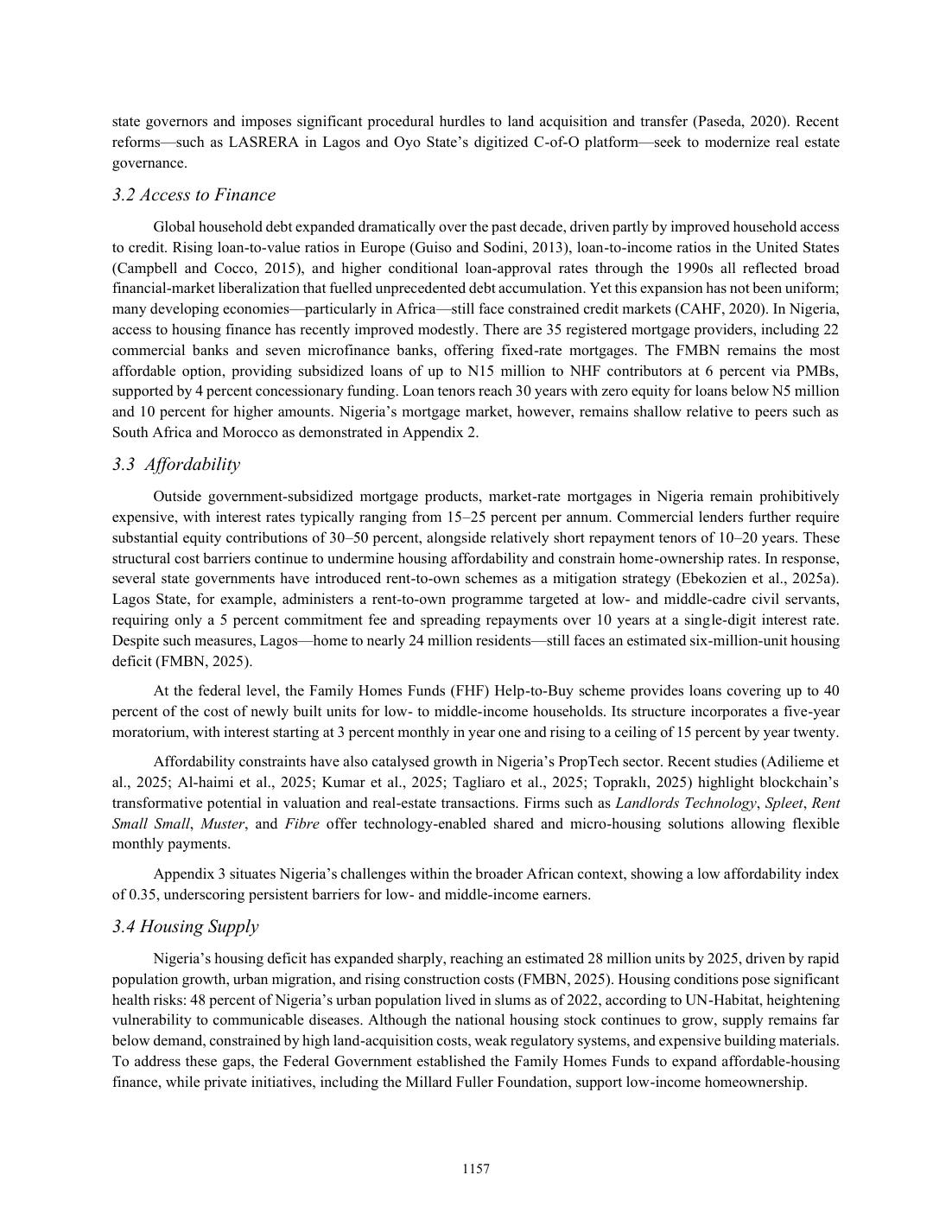
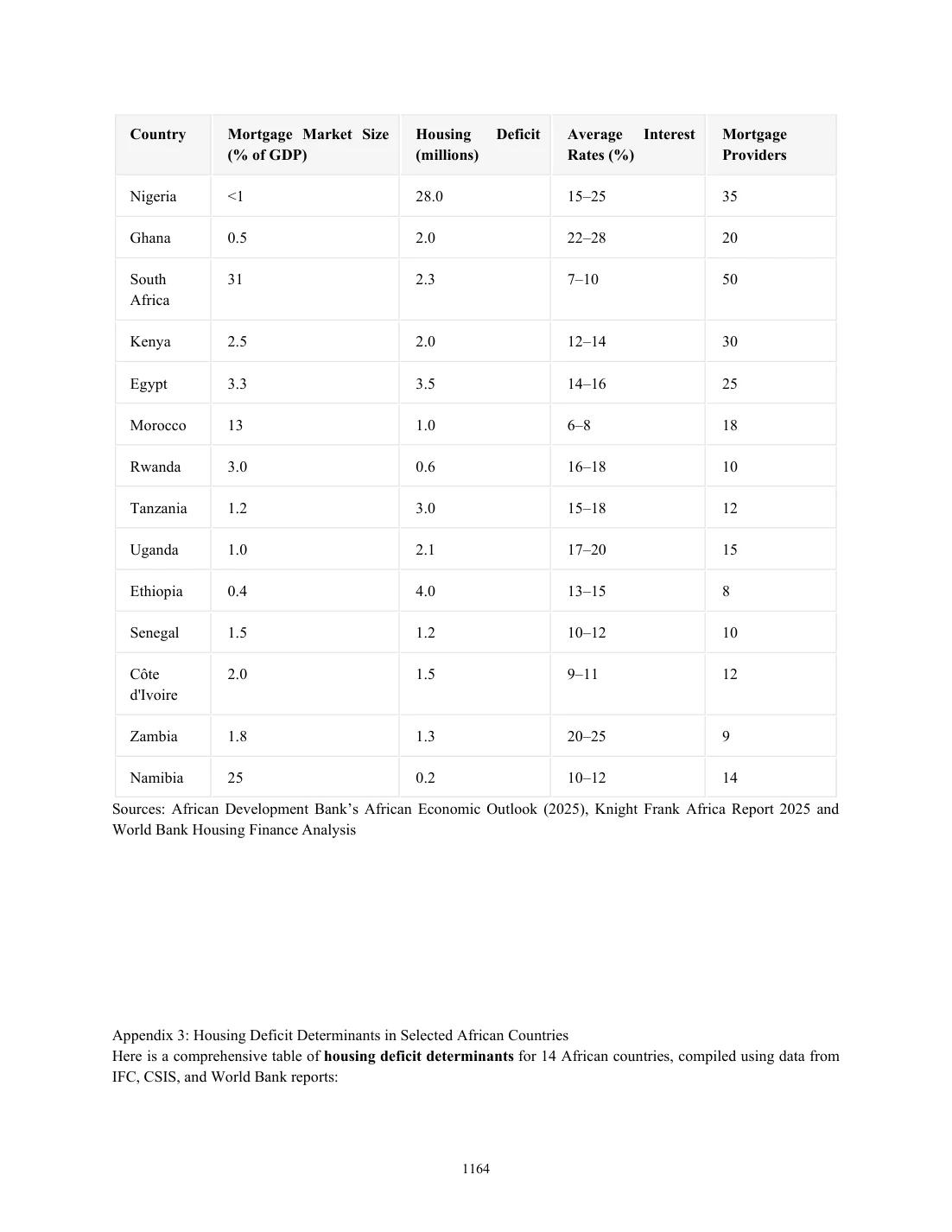
state governors and imposes significant procedural hurdles to land acquisition and transfer (Paseda, 2020). Recent reforms—such as LASRERA in Lagos and Oyo State’s digitized C-of-O platform—seek to modernize real estate governance. 3.2 Access to Finance Global household debt expanded dramatically over the past decade, driven partly by improved household access to credit. Rising loan-to-value ratios in Europe (Guiso and Sodini, 2013), loan-to-income ratios in the United States (Campbell and Cocco, 2015), and higher conditional loan-approval rates through the 1990s all reflected broad financial-market liberalization that fuelled unprecedented debt accumulation. Yet this expansion has not been uniform; many developing economies—particularly in Africa—still face constrained credit markets (CAHF, 2020). In Nigeria, access to housing finance has recently improved modestly. There are 35 registered mortgage providers, including 22 commercial banks and seven microfinance banks, offering fixed-rate mortgages. The FMBN remains the most affordable option, providing subsidized loans of up to N15 million to NHF contributors at 6 percent via PMBs, supported by 4 percent concessionary funding. Loan tenors reach 30 years with zero equity for loans below N5 million and 10 percent for higher amounts. Nigeria’s mortgage market, however, remains shallow relative to peers such as South Africa and Morocco as demonstrated in Appendix 2. 3.3 Affordability Outside government-subsidized mortgage products, market-rate mortgages in Nigeria remain prohibitively expensive, with interest rates typically ranging from 15–25 percent per annum. Commercial lenders further require substantial equity contributions of 30–50 percent, alongside relatively short repayment tenors of 10–20 years. These structural cost barriers continue to undermine housing affordability and constrain home-ownership rates. In response, several state governments have introduced rent-to-own schemes as a mitigation strategy (Ebekozien et al., 2025a). Lagos State, for example, administers a rent-to-own programme targeted at low- and middle-cadre civil servants, requiring only a 5 percent commitment fee and spreading repayments over 10 years at a single-digit interest rate. Despite such measures, Lagos—home to nearly 24 million residents—still faces an estimated six-million-unit housing deficit (FMBN, 2025). At the federal level, the Family Homes Funds (FHF) Help-to-Buy scheme provides loans covering up to 40 percent of the cost of newly built units for low- to middle-income households. Its structure incorporates a five-year moratorium, with interest starting at 3 percent monthly in year one and rising to a ceiling of 15 percent by year twenty. Affordability constraints have also catalysed growth in Nigeria’s PropTech sector. Recent studies (Adilieme et al., 2025; Al-haimi et al., 2025; Kumar et al., 2025; Tagliaro et al., 2025; Topraklı, 2025) highlight blockchain’s transformative potential in valuation and real-estate transactions. Firms such as Landlords Technology, Spleet, Rent Small Small, Muster, and Fibre offer technology-enabled shared and micro-housing solutions allowing flexible monthly payments. Appendix 3 situates Nigeria’s challenges within the broader African context, showing a low affordability index of 0.35, underscoring persistent barriers for low- and middle-income earners. 3.4 Housing Supply Nigeria’s housing deficit has expanded sharply, reaching an estimated 28 million units by 2025, driven by rapid population growth, urban migration, and rising construction costs (FMBN, 2025). Housing conditions pose significant health risks: 48 percent of Nigeria’s urban population lived in slums as of 2022, according to UN-Habitat, heightening vulnerability to communicable diseases. Although the national housing stock continues to grow, supply remains far below demand, constrained by high land-acquisition costs, weak regulatory systems, and expensive building materials. To address these gaps, the Federal Government established the Family Homes Funds to expand affordable-housing finance, while private initiatives, including the Millard Fuller Foundation, support low-income homeownership. 1157
Page 6 of 17
Read page 6 as text
Refer to the original page for equations and table layout.
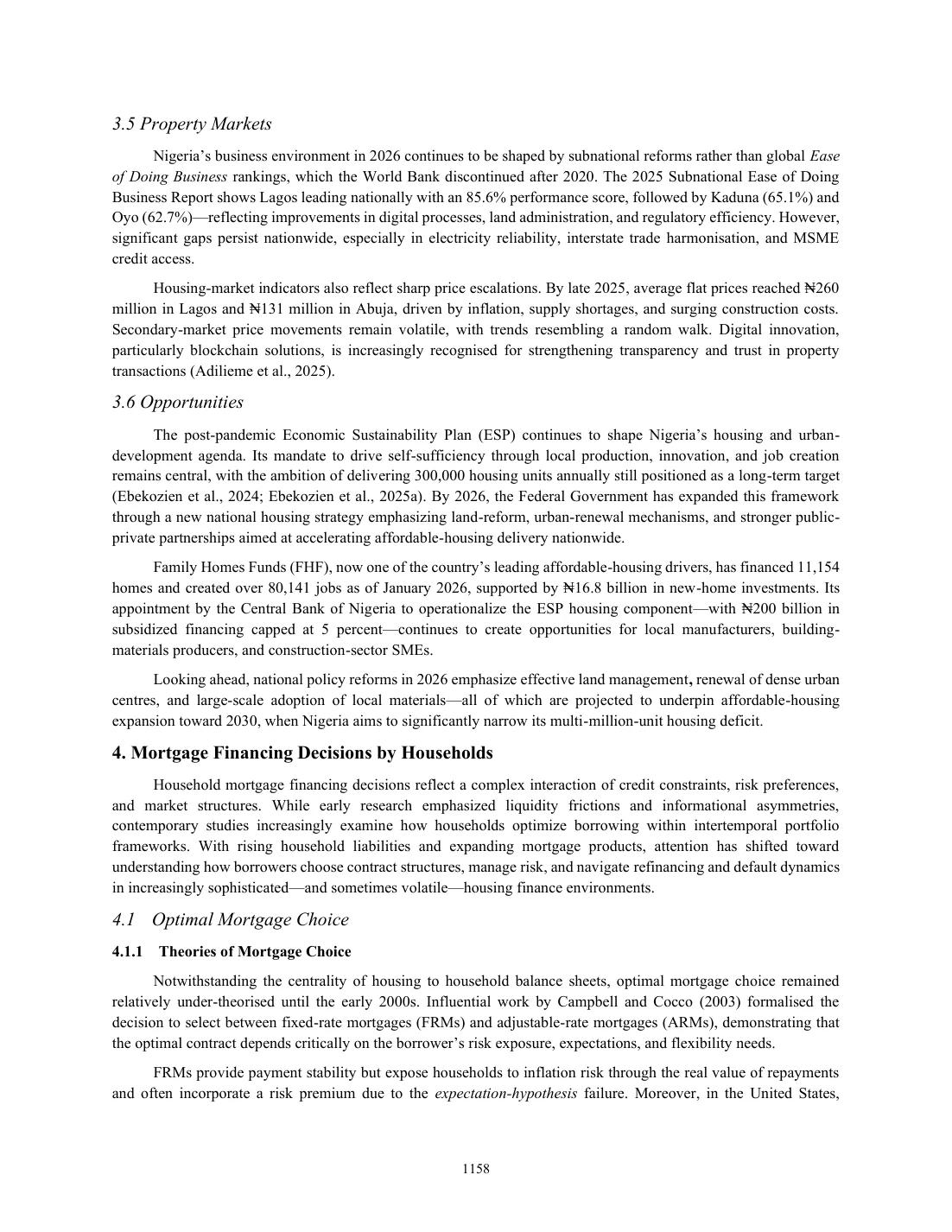
3.5 Property Markets Nigeria’s business environment in 2026 continues to be shaped by subnational reforms rather than global Ease of Doing Business rankings, which the World Bank discontinued after 2020. The 2025 Subnational Ease of Doing Business Report shows Lagos leading nationally with an 85.6% performance score, followed by Kaduna (65.1%) and Oyo (62.7%)—reflecting improvements in digital processes, land administration, and regulatory efficiency. However, significant gaps persist nationwide, especially in electricity reliability, interstate trade harmonisation, and MSME credit access. Housing-market indicators also reflect sharp price escalations. By late 2025, average flat prices reached ₦260 million in Lagos and ₦131 million in Abuja, driven by inflation, supply shortages, and surging construction costs. Secondary-market price movements remain volatile, with trends resembling a random walk. Digital innovation, particularly blockchain solutions, is increasingly recognised for strengthening transparency and trust in property transactions (Adilieme et al., 2025). 3.6 Opportunities The post-pandemic Economic Sustainability Plan (ESP) continues to shape Nigeria’s housing and urban- development agenda. Its mandate to drive self-sufficiency through local production, innovation, and job creation remains central, with the ambition of delivering 300,000 housing units annually still positioned as a long-term target (Ebekozien et al., 2024; Ebekozien et al., 2025a). By 2026, the Federal Government has expanded this framework through a new national housing strategy emphasizing land-reform, urban-renewal mechanisms, and stronger public- private partnerships aimed at accelerating affordable-housing delivery nationwide. Family Homes Funds (FHF), now one of the country’s leading affordable-housing drivers, has financed 11,154 homes and created over 80,141 jobs as of January 2026, supported by ₦16.8 billion in new-home investments. Its appointment by the Central Bank of Nigeria to operationalize the ESP housing component—with ₦200 billion in subsidized financing capped at 5 percent—continues to create opportunities for local manufacturers, building- materials producers, and construction-sector SMEs. Looking ahead, national policy reforms in 2026 emphasize effective land management, renewal of dense urban centres, and large-scale adoption of local materials—all of which are projected to underpin affordable-housing expansion toward 2030, when Nigeria aims to significantly narrow its multi-million-unit housing deficit. 4. Mortgage Financing Decisions by Households Household mortgage financing decisions reflect a complex interaction of credit constraints, risk preferences, and market structures. While early research emphasized liquidity frictions and informational asymmetries, contemporary studies increasingly examine how households optimize borrowing within intertemporal portfolio frameworks. With rising household liabilities and expanding mortgage products, attention has shifted toward understanding how borrowers choose contract structures, manage risk, and navigate refinancing and default dynamics in increasingly sophisticated—and sometimes volatile—housing finance environments. 4.1 Optimal Mortgage Choice 4.1.1 Theories of Mortgage Choice Notwithstanding the centrality of housing to household balance sheets, optimal mortgage choice remained relatively under-theorised until the early 2000s. Influential work by Campbell and Cocco (2003) formalised the decision to select between fixed-rate mortgages (FRMs) and adjustable-rate mortgages (ARMs), demonstrating that the optimal contract depends critically on the borrower’s risk exposure, expectations, and flexibility needs. FRMs provide payment stability but expose households to inflation risk through the real value of repayments and often incorporate a risk premium due to the expectation-hypothesis failure. Moreover, in the United States, 1158
Page 7 of 17
Read page 7 as text
Refer to the original page for equations and table layout.
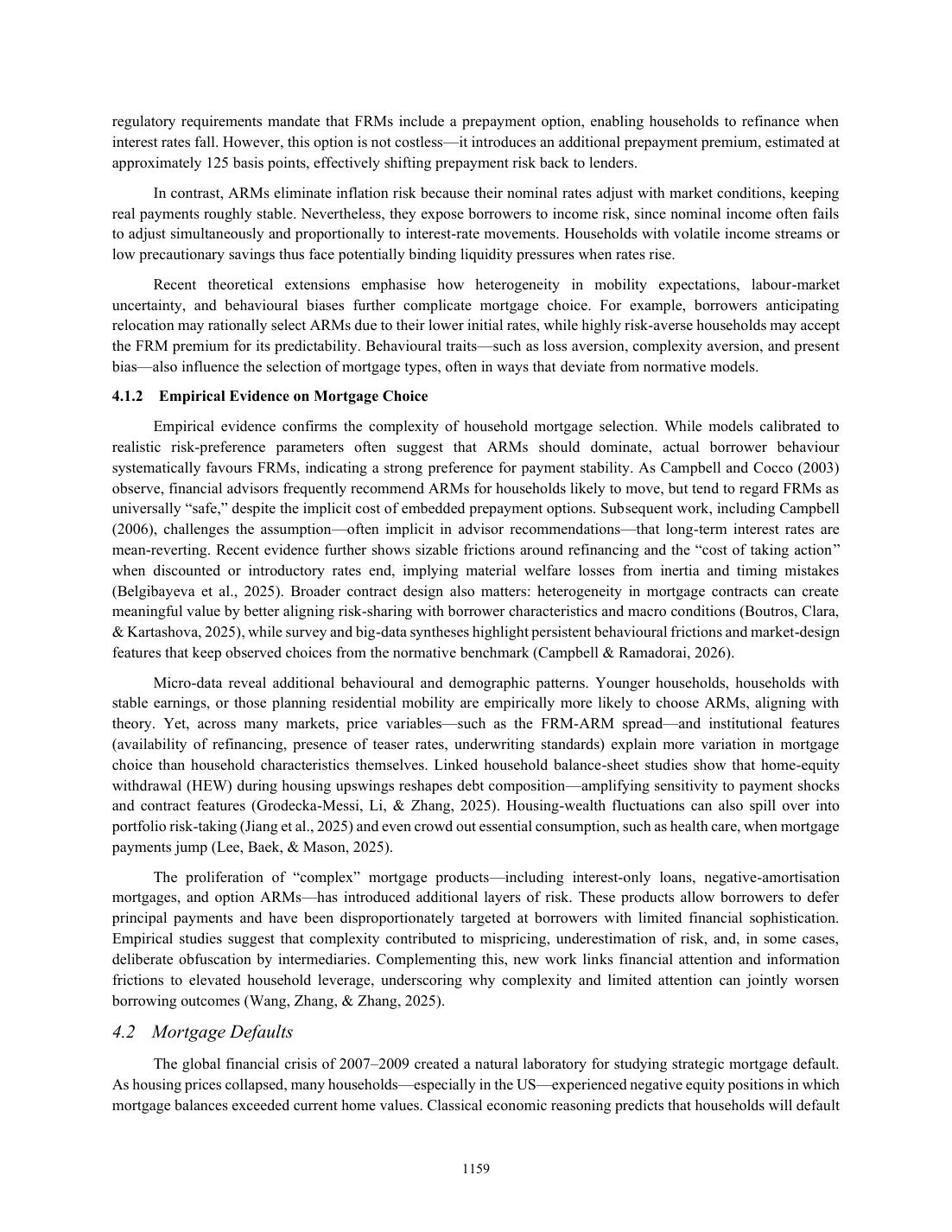
regulatory requirements mandate that FRMs include a prepayment option, enabling households to refinance when interest rates fall. However, this option is not costless—it introduces an additional prepayment premium, estimated at approximately 125 basis points, effectively shifting prepayment risk back to lenders. In contrast, ARMs eliminate inflation risk because their nominal rates adjust with market conditions, keeping real payments roughly stable. Nevertheless, they expose borrowers to income risk, since nominal income often fails to adjust simultaneously and proportionally to interest-rate movements. Households with volatile income streams or low precautionary savings thus face potentially binding liquidity pressures when rates rise. Recent theoretical extensions emphasise how heterogeneity in mobility expectations, labour-market uncertainty, and behavioural biases further complicate mortgage choice. For example, borrowers anticipating relocation may rationally select ARMs due to their lower initial rates, while highly risk-averse households may accept the FRM premium for its predictability. Behavioural traits—such as loss aversion, complexity aversion, and present bias—also influence the selection of mortgage types, often in ways that deviate from normative models. 4.1.2 Empirical Evidence on Mortgage Choice Empirical evidence confirms the complexity of household mortgage selection. While models calibrated to realistic risk-preference parameters often suggest that ARMs should dominate, actual borrower behaviour systematically favours FRMs, indicating a strong preference for payment stability. As Campbell and Cocco (2003) observe, financial advisors frequently recommend ARMs for households likely to move, but tend to regard FRMs as universally “safe,” despite the implicit cost of embedded prepayment options. Subsequent work, including Campbell (2006), challenges the assumption—often implicit in advisor recommendations—that long-term interest rates are mean-reverting. Recent evidence further shows sizable frictions around refinancing and the “cost of taking action” when discounted or introductory rates end, implying material welfare losses from inertia and timing mistakes (Belgibayeva et al., 2025). Broader contract design also matters: heterogeneity in mortgage contracts can create meaningful value by better aligning risk-sharing with borrower characteristics and macro conditions (Boutros, Clara, & Kartashova, 2025), while survey and big-data syntheses highlight persistent behavioural frictions and market-design features that keep observed choices from the normative benchmark (Campbell & Ramadorai, 2026). Micro-data reveal additional behavioural and demographic patterns. Younger households, households with stable earnings, or those planning residential mobility are empirically more likely to choose ARMs, aligning with theory. Yet, across many markets, price variables—such as the FRM-ARM spread—and institutional features (availability of refinancing, presence of teaser rates, underwriting standards) explain more variation in mortgage choice than household characteristics themselves. Linked household balance-sheet studies show that home-equity withdrawal (HEW) during housing upswings reshapes debt composition—amplifying sensitivity to payment shocks and contract features (Grodecka-Messi, Li, & Zhang, 2025). Housing-wealth fluctuations can also spill over into portfolio risk-taking (Jiang et al., 2025) and even crowd out essential consumption, such as health care, when mortgage payments jump (Lee, Baek, & Mason, 2025). The proliferation of “complex” mortgage products—including interest-only loans, negative-amortisation mortgages, and option ARMs—has introduced additional layers of risk. These products allow borrowers to defer principal payments and have been disproportionately targeted at borrowers with limited financial sophistication. Empirical studies suggest that complexity contributed to mispricing, underestimation of risk, and, in some cases, deliberate obfuscation by intermediaries. Complementing this, new work links financial attention and information frictions to elevated household leverage, underscoring why complexity and limited attention can jointly worsen borrowing outcomes (Wang, Zhang, & Zhang, 2025). 4.2 Mortgage Defaults The global financial crisis of 2007–2009 created a natural laboratory for studying strategic mortgage default. As housing prices collapsed, many households—especially in the US—experienced negative equity positions in which mortgage balances exceeded current home values. Classical economic reasoning predicts that households will default 1159
Page 8 of 17
Read page 8 as text
Refer to the original page for equations and table layout.
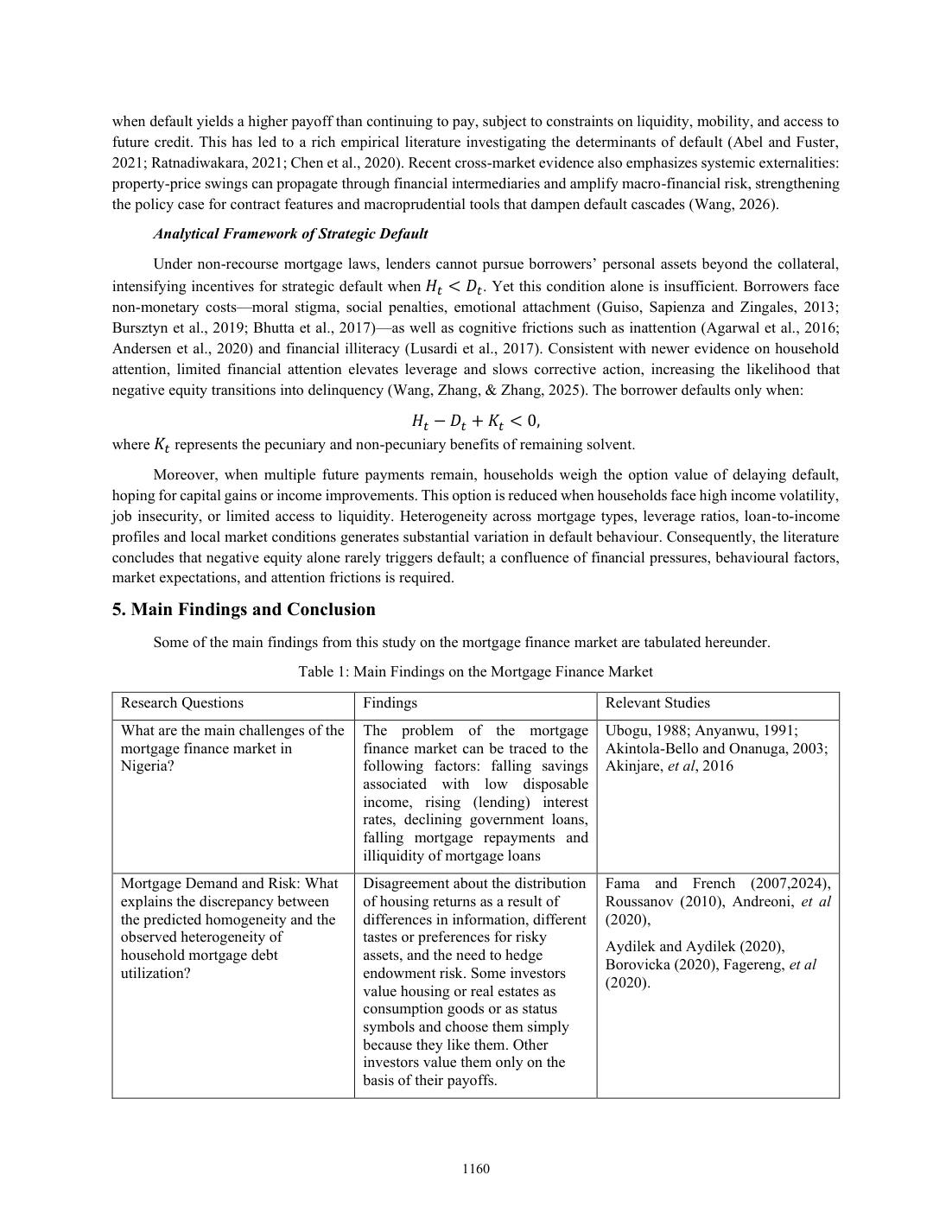
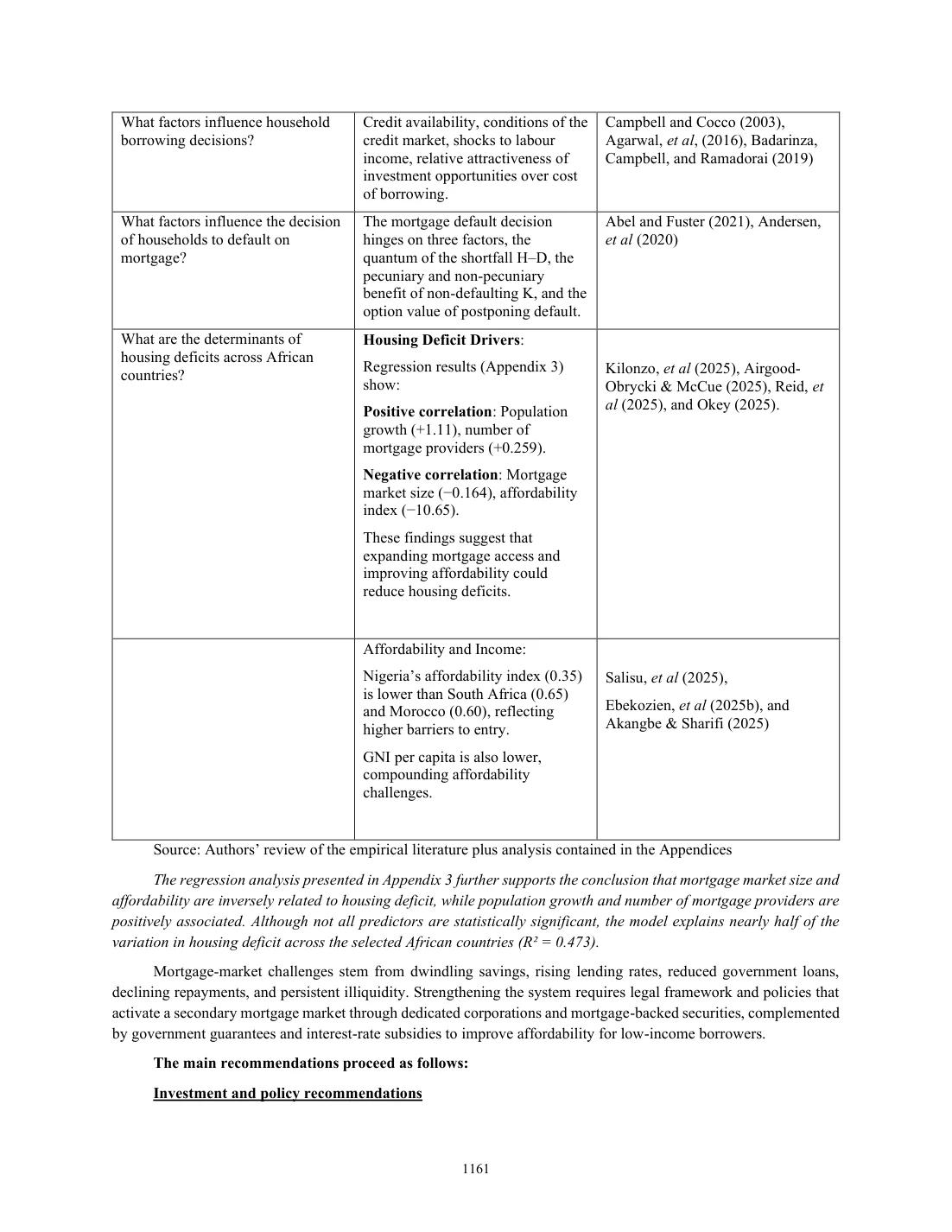
when default yields a higher payoff than continuing to pay, subject to constraints on liquidity, mobility, and access to future credit. This has led to a rich empirical literature investigating the determinants of default (Abel and Fuster, 2021; Ratnadiwakara, 2021; Chen et al., 2020). Recent cross-market evidence also emphasizes systemic externalities: property-price swings can propagate through financial intermediaries and amplify macro-financial risk, strengthening the policy case for contract features and macroprudential tools that dampen default cascades (Wang, 2026). Analytical Framework of Strategic Default Under non-recourse mortgage laws, lenders cannot pursue borrowers’ personal assets beyond the collateral, intensifying incentives for strategic default when 𝐻𝑡< 𝐷𝑡. Yet this condition alone is insufficient. Borrowers face non-monetary costs—moral stigma, social penalties, emotional attachment (Guiso, Sapienza and Zingales, 2013; Bursztyn et al., 2019; Bhutta et al., 2017)—as well as cognitive frictions such as inattention (Agarwal et al., 2016; Andersen et al., 2020) and financial illiteracy (Lusardi et al., 2017). Consistent with newer evidence on household attention, limited financial attention elevates leverage and slows corrective action, increasing the likelihood that negative equity transitions into delinquency (Wang, Zhang, & Zhang, 2025). The borrower defaults only when: 𝐻𝑡−𝐷𝑡+ 𝐾𝑡< 0, where 𝐾𝑡 represents the pecuniary and non-pecuniary benefits of remaining solvent. Moreover, when multiple future payments remain, households weigh the option value of delaying default, hoping for capital gains or income improvements. This option is reduced when households face high income volatility, job insecurity, or limited access to liquidity. Heterogeneity across mortgage types, leverage ratios, loan-to-income profiles and local market conditions generates substantial variation in default behaviour. Consequently, the literature concludes that negative equity alone rarely triggers default; a confluence of financial pressures, behavioural factors, market expectations, and attention frictions is required. 5. Main Findings and Conclusion Some of the main findings from this study on the mortgage finance market are tabulated hereunder. Table 1: Main Findings on the Mortgage Finance Market Research Questions Findings Relevant Studies What are the main challenges of the The problem of the mortgage Ubogu, 1988; Anyanwu, 1991; mortgage finance market in finance market can be traced to the Akintola-Bello and Onanuga, 2003; Nigeria? following factors: falling savings Akinjare, et al, 2016 associated with low disposable income, rising (lending) interest rates, declining government loans, falling mortgage repayments and illiquidity of mortgage loans Mortgage Demand and Risk: What Disagreement about the distribution Fama and French (2007,2024), explains the discrepancy between of housing returns as a result of Roussanov (2010), Andreoni, et al the predicted homogeneity and the differences in information, different (2020), observed heterogeneity of tastes or preferences for risky Aydilek and Aydilek (2020), household mortgage debt assets, and the need to hedge Borovicka (2020), Fagereng, et al utilization? endowment risk. Some investors (2020). value housing or real estates as consumption goods or as status symbols and choose them simply because they like them. Other investors value them only on the basis of their payoffs. 1160
Page 9 of 17
Read page 9 as text
Refer to the original page for equations and table layout.
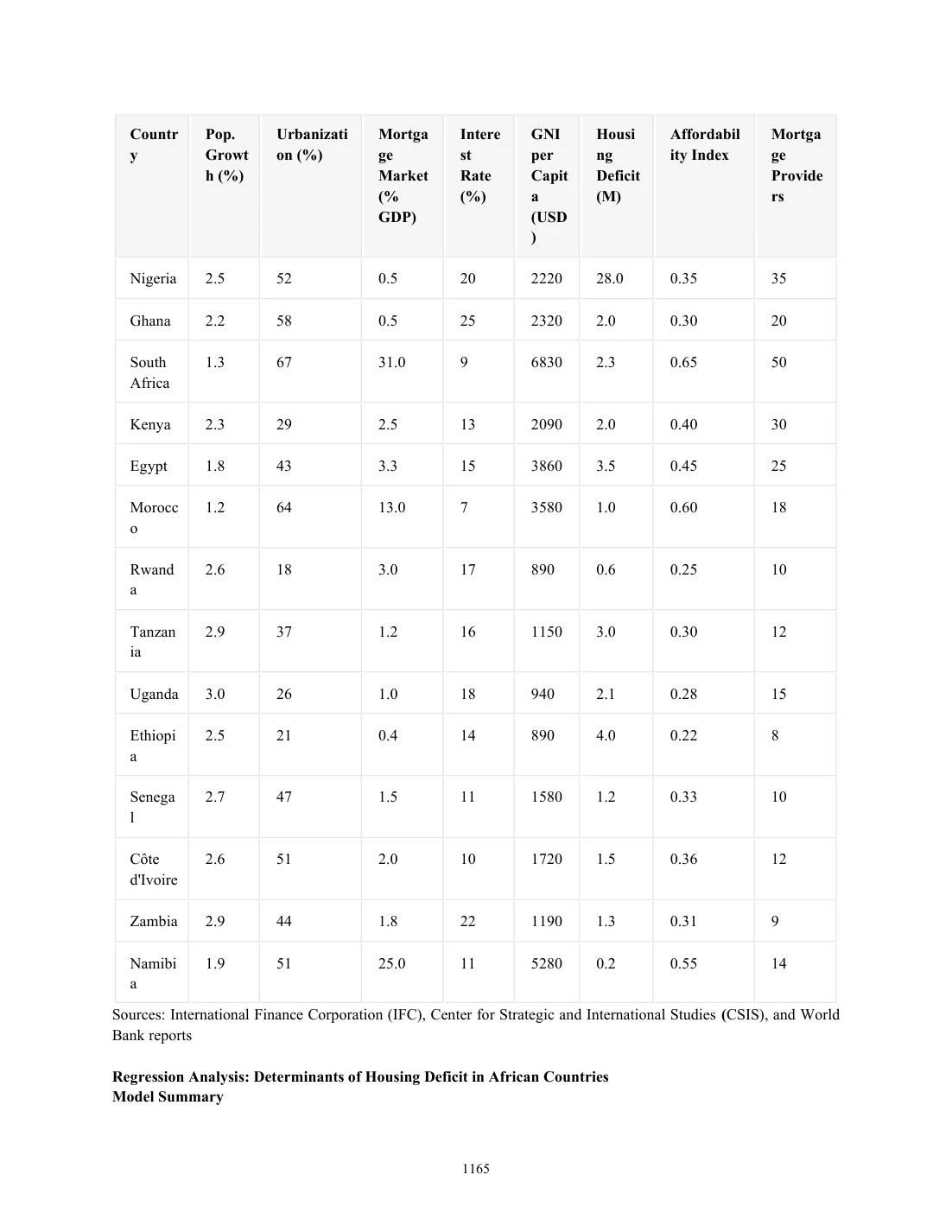
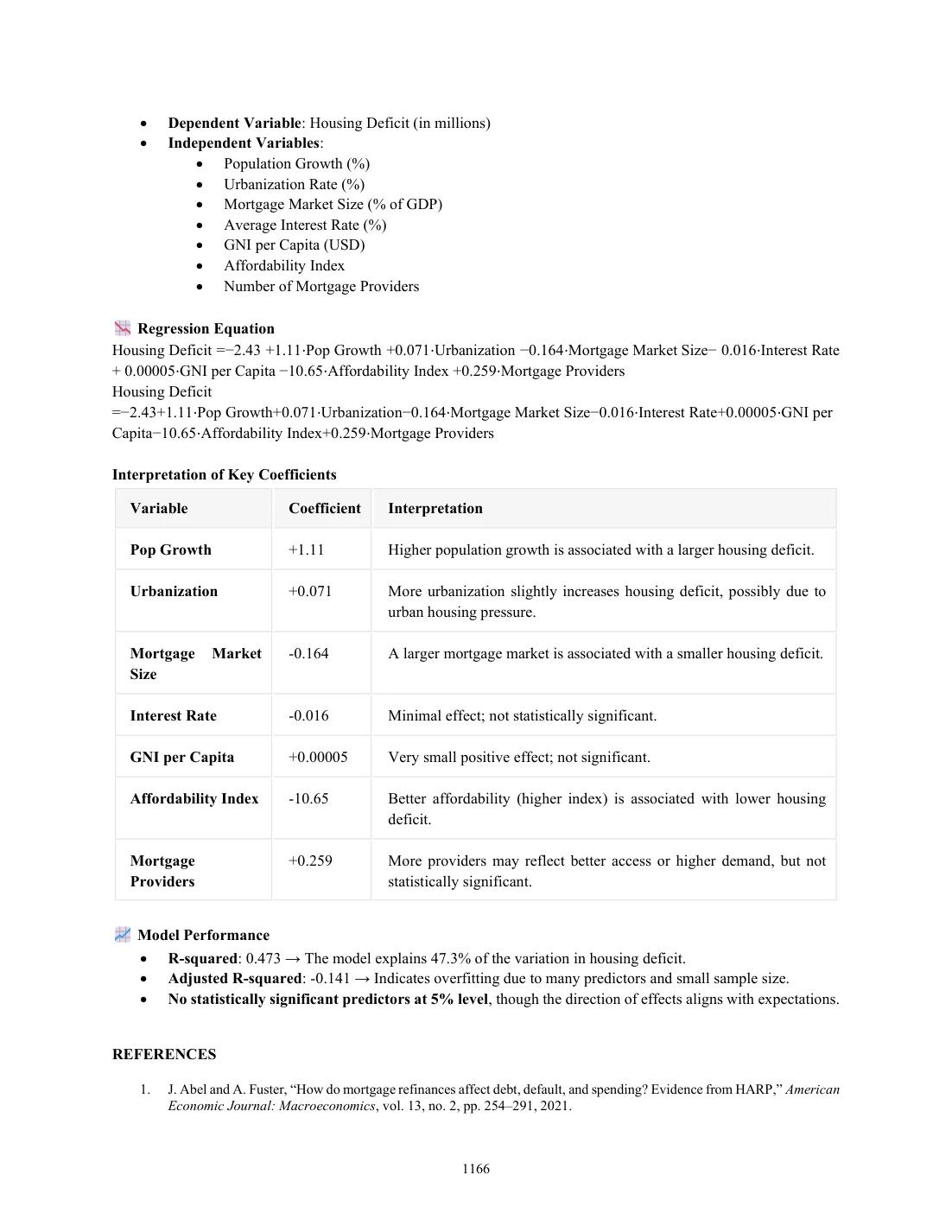
What factors influence household Credit availability, conditions of the Campbell and Cocco (2003), borrowing decisions? credit market, shocks to labour Agarwal, et al, (2016), Badarinza, income, relative attractiveness of Campbell, and Ramadorai (2019) investment opportunities over cost of borrowing. What factors influence the decision The mortgage default decision Abel and Fuster (2021), Andersen, of households to default on hinges on three factors, the et al (2020) mortgage? quantum of the shortfall H–D, the pecuniary and non-pecuniary benefit of non-defaulting K, and the option value of postponing default. What are the determinants of Housing Deficit Drivers: housing deficits across African Regression results (Appendix 3) Kilonzo, et al (2025), Airgood- countries? show: Obrycki & McCue (2025), Reid, et al (2025), and Okey (2025). Positive correlation: Population growth (+1.11), number of mortgage providers (+0.259). Negative correlation: Mortgage market size (−0.164), affordability index (−10.65). These findings suggest that expanding mortgage access and improving affordability could reduce housing deficits. Affordability and Income: Nigeria’s affordability index (0.35) Salisu, et al (2025), is lower than South Africa (0.65) Ebekozien, et al (2025b), and and Morocco (0.60), reflecting Akangbe & Sharifi (2025) higher barriers to entry. GNI per capita is also lower, compounding affordability challenges. Source: Authors’ review of the empirical literature plus analysis contained in the Appendices The regression analysis presented in Appendix 3 further supports the conclusion that mortgage market size and affordability are inversely related to housing deficit, while population growth and number of mortgage providers are positively associated. Although not all predictors are statistically significant, the model explains nearly half of the variation in housing deficit across the selected African countries (R² = 0.473). Mortgage-market challenges stem from dwindling savings, rising lending rates, reduced government loans, declining repayments, and persistent illiquidity. Strengthening the system requires legal framework and policies that activate a secondary mortgage market through dedicated corporations and mortgage-backed securities, complemented by government guarantees and interest-rate subsidies to improve affordability for low-income borrowers. The main recommendations proceed as follows: Investment and policy recommendations 1161
Page 10 of 17
Read page 10 as text
Refer to the original page for equations and table layout.
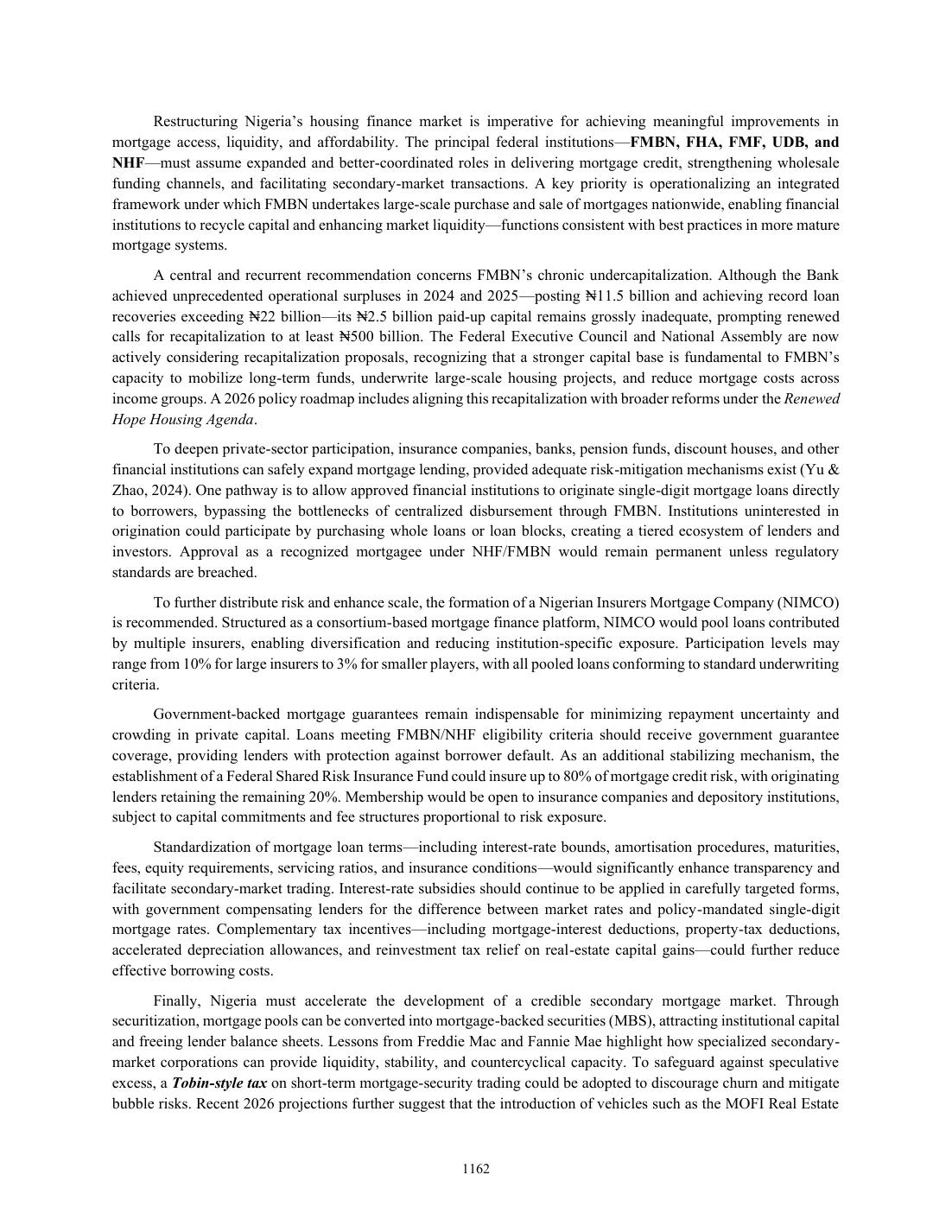
Restructuring Nigeria’s housing finance market is imperative for achieving meaningful improvements in mortgage access, liquidity, and affordability. The principal federal institutions—FMBN, FHA, FMF, UDB, and NHF—must assume expanded and better-coordinated roles in delivering mortgage credit, strengthening wholesale funding channels, and facilitating secondary-market transactions. A key priority is operationalizing an integrated framework under which FMBN undertakes large-scale purchase and sale of mortgages nationwide, enabling financial institutions to recycle capital and enhancing market liquidity—functions consistent with best practices in more mature mortgage systems. A central and recurrent recommendation concerns FMBN’s chronic undercapitalization. Although the Bank achieved unprecedented operational surpluses in 2024 and 2025—posting ₦11.5 billion and achieving record loan recoveries exceeding ₦22 billion—its ₦2.5 billion paid-up capital remains grossly inadequate, prompting renewed calls for recapitalization to at least ₦500 billion. The Federal Executive Council and National Assembly are now actively considering recapitalization proposals, recognizing that a stronger capital base is fundamental to FMBN’s capacity to mobilize long-term funds, underwrite large-scale housing projects, and reduce mortgage costs across income groups. A 2026 policy roadmap includes aligning this recapitalization with broader reforms under the Renewed Hope Housing Agenda. To deepen private-sector participation, insurance companies, banks, pension funds, discount houses, and other financial institutions can safely expand mortgage lending, provided adequate risk-mitigation mechanisms exist (Yu & Zhao, 2024). One pathway is to allow approved financial institutions to originate single-digit mortgage loans directly to borrowers, bypassing the bottlenecks of centralized disbursement through FMBN. Institutions uninterested in origination could participate by purchasing whole loans or loan blocks, creating a tiered ecosystem of lenders and investors. Approval as a recognized mortgagee under NHF/FMBN would remain permanent unless regulatory standards are breached. To further distribute risk and enhance scale, the formation of a Nigerian Insurers Mortgage Company (NIMCO) is recommended. Structured as a consortium-based mortgage finance platform, NIMCO would pool loans contributed by multiple insurers, enabling diversification and reducing institution-specific exposure. Participation levels may range from 10% for large insurers to 3% for smaller players, with all pooled loans conforming to standard underwriting criteria. Government-backed mortgage guarantees remain indispensable for minimizing repayment uncertainty and crowding in private capital. Loans meeting FMBN/NHF eligibility criteria should receive government guarantee coverage, providing lenders with protection against borrower default. As an additional stabilizing mechanism, the establishment of a Federal Shared Risk Insurance Fund could insure up to 80% of mortgage credit risk, with originating lenders retaining the remaining 20%. Membership would be open to insurance companies and depository institutions, subject to capital commitments and fee structures proportional to risk exposure. Standardization of mortgage loan terms—including interest-rate bounds, amortisation procedures, maturities, fees, equity requirements, servicing ratios, and insurance conditions—would significantly enhance transparency and facilitate secondary-market trading. Interest-rate subsidies should continue to be applied in carefully targeted forms, with government compensating lenders for the difference between market rates and policy-mandated single-digit mortgage rates. Complementary tax incentives—including mortgage-interest deductions, property-tax deductions, accelerated depreciation allowances, and reinvestment tax relief on real-estate capital gains—could further reduce effective borrowing costs. Finally, Nigeria must accelerate the development of a credible secondary mortgage market. Through securitization, mortgage pools can be converted into mortgage-backed securities (MBS), attracting institutional capital and freeing lender balance sheets. Lessons from Freddie Mac and Fannie Mae highlight how specialized secondary- market corporations can provide liquidity, stability, and countercyclical capacity. To safeguard against speculative excess, a Tobin-style tax on short-term mortgage-security trading could be adopted to discourage churn and mitigate bubble risks. Recent 2026 projections further suggest that the introduction of vehicles such as the MOFI Real Estate 1162
Page 11 of 17
Read page 11 as text
Refer to the original page for equations and table layout.
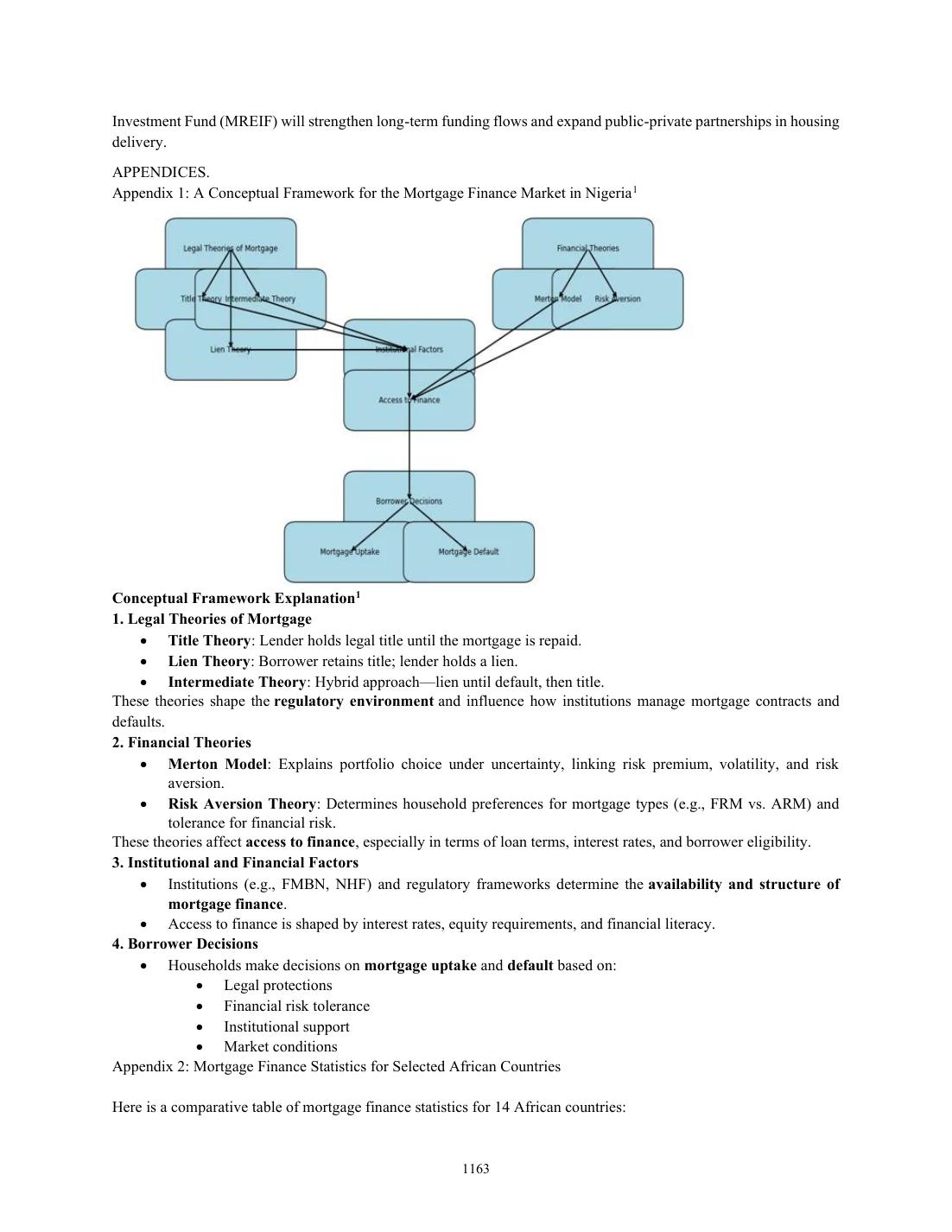
Investment Fund (MREIF) will strengthen long-term funding flows and expand public-private partnerships in housing delivery. APPENDICES. Appendix 1: A Conceptual Framework for the Mortgage Finance Market in Nigeria1 Conceptual Framework Explanation1 1. Legal Theories of Mortgage • Title Theory: Lender holds legal title until the mortgage is repaid. • Lien Theory: Borrower retains title; lender holds a lien. • Intermediate Theory: Hybrid approach—lien until default, then title. These theories shape the regulatory environment and influence how institutions manage mortgage contracts and defaults. 2. Financial Theories • Merton Model: Explains portfolio choice under uncertainty, linking risk premium, volatility, and risk aversion. • Risk Aversion Theory: Determines household preferences for mortgage types (e.g., FRM vs. ARM) and tolerance for financial risk. These theories affect access to finance, especially in terms of loan terms, interest rates, and borrower eligibility. 3. Institutional and Financial Factors • Institutions (e.g., FMBN, NHF) and regulatory frameworks determine the availability and structure of mortgage finance. • Access to finance is shaped by interest rates, equity requirements, and financial literacy. 4. Borrower Decisions • Households make decisions on mortgage uptake and default based on: • Legal protections • Financial risk tolerance • Institutional support • Market conditions Appendix 2: Mortgage Finance Statistics for Selected African Countries Here is a comparative table of mortgage finance statistics for 14 African countries: 1163
Page 12 of 17
Read page 12 as text
Refer to the original page for equations and table layout.
Country Mortgage Market Size Housing Deficit Average Interest Mortgage (% of GDP) (millions) Rates (%) Providers Nigeria <1 28.0 15–25 35 Ghana 0.5 2.0 22–28 20 South 31 2.3 7–10 50 Africa Kenya 2.5 2.0 12–14 30 Egypt 3.3 3.5 14–16 25 Morocco 13 1.0 6–8 18 Rwanda 3.0 0.6 16–18 10 Tanzania 1.2 3.0 15–18 12 Uganda 1.0 2.1 17–20 15 Ethiopia 0.4 4.0 13–15 8 Senegal 1.5 1.2 10–12 10 Côte 2.0 1.5 9–11 12 d'Ivoire Zambia 1.8 1.3 20–25 9 Namibia 25 0.2 10–12 14 Sources: African Development Bank’s African Economic Outlook (2025), Knight Frank Africa Report 2025 and World Bank Housing Finance Analysis Appendix 3: Housing Deficit Determinants in Selected African Countries Here is a comprehensive table of housing deficit determinants for 14 African countries, compiled using data from IFC, CSIS, and World Bank reports: 1164
Page 13 of 17
Read page 13 as text
Refer to the original page for equations and table layout.
Countr Pop. Urbanizati Mortga Intere GNI Housi Affordabil Mortga y Growt on (%) ge st per ng ity Index ge h (%) Market Rate Capit Deficit Provide (% (%) a (M) rs GDP) (USD ) Nigeria 2.5 52 0.5 20 2220 28.0 0.35 35 Ghana 2.2 58 0.5 25 2320 2.0 0.30 20 South 1.3 67 31.0 9 6830 2.3 0.65 50 Africa Kenya 2.3 29 2.5 13 2090 2.0 0.40 30 Egypt 1.8 43 3.3 15 3860 3.5 0.45 25 Morocc 1.2 64 13.0 7 3580 1.0 0.60 18 o Rwand 2.6 18 3.0 17 890 0.6 0.25 10 a Tanzan 2.9 37 1.2 16 1150 3.0 0.30 12 ia Uganda 3.0 26 1.0 18 940 2.1 0.28 15 Ethiopi 2.5 21 0.4 14 890 4.0 0.22 8 a Senega 2.7 47 1.5 11 1580 1.2 0.33 10 l Côte 2.6 51 2.0 10 1720 1.5 0.36 12 d'Ivoire Zambia 2.9 44 1.8 22 1190 1.3 0.31 9 Namibi 1.9 51 25.0 11 5280 0.2 0.55 14 a Sources: International Finance Corporation (IFC), Center for Strategic and International Studies (CSIS), and World Bank reports Regression Analysis: Determinants of Housing Deficit in African Countries Model Summary 1165
Page 14 of 17
Read page 14 as text
Refer to the original page for equations and table layout.
• Dependent Variable: Housing Deficit (in millions) • Independent Variables: • Population Growth (%) • Urbanization Rate (%) • Mortgage Market Size (% of GDP) • Average Interest Rate (%) • GNI per Capita (USD) • Affordability Index • Number of Mortgage Providers Regression Equation Housing Deficit =−2.43 +1.11⋅Pop Growth +0.071⋅Urbanization −0.164⋅Mortgage Market Size− 0.016⋅Interest Rate + 0.00005⋅GNI per Capita −10.65⋅Affordability Index +0.259⋅Mortgage Providers Housing Deficit =−2.43+1.11⋅Pop Growth+0.071⋅Urbanization−0.164⋅Mortgage Market Size−0.016⋅Interest Rate+0.00005⋅GNI per Capita−10.65⋅Affordability Index+0.259⋅Mortgage Providers Interpretation of Key Coefficients Variable Coefficient Interpretation Pop Growth +1.11 Higher population growth is associated with a larger housing deficit. Urbanization +0.071 More urbanization slightly increases housing deficit, possibly due to urban housing pressure. Mortgage Market -0.164 A larger mortgage market is associated with a smaller housing deficit. Size Interest Rate -0.016 Minimal effect; not statistically significant. GNI per Capita +0.00005 Very small positive effect; not significant. Affordability Index -10.65 Better affordability (higher index) is associated with lower housing deficit. Mortgage +0.259 More providers may reflect better access or higher demand, but not Providers statistically significant. Model Performance • R-squared: 0.473 → The model explains 47.3% of the variation in housing deficit. • Adjusted R-squared: -0.141 → Indicates overfitting due to many predictors and small sample size. • No statistically significant predictors at 5% level, though the direction of effects aligns with expectations. REFERENCES 1. J. Abel and A. Fuster, “How do mortgage refinances affect debt, default, and spending? Evidence from HARP,” American Economic Journal: Macroeconomics, vol. 13, no. 2, pp. 254–291, 2021. 1166
Page 15 of 17
Read page 15 as text
Refer to the original page for equations and table layout.
2. C. M. Adilieme, R. B. Abidoye, and C. L. Lee, “Barriers and prospects for the adoption of blockchain technology in property valuation,” Journal of European Real Estate Research, vol. 18, no. 1, pp. 84–104, 2025. 3. S. Agarwal, R. J. Rosen, and V. Yao, “Why do borrowers make mortgage refinancing mistakes?” Management Science, vol. 62, no. 12, pp. 3494–3509, 2016. 4. W. Airgood-Obrycki and D. McCue, “The housing shortage is still out there,” Housing Policy Debate, vol. 35, no. 1, pp. 75–79, 2025. 5. O. Akangbe and A. Sharifi, “Nigeria’s Path to Green Energy Transition: Insights from Business Preferences for Solar PV Adoption,” Renewable Energy, 2025, Art. no. 123604. 6. V. Akinjare, K. A. Adetiloye, A. A. Isibor, and T. Okafor, “The assessment of the contribution of primary mortgage institutions to housing finance in Nigeria: A case study of Union Homes Savings and Loans Plc,” Asian Journal of Information Technology, vol. 15, no. 13, pp. 2094–2100, 2016. 7. O. Akintola-Bello, “Insurance industry and the Nigerian economy,” Savings and Development, vol. 9, no. 1, pp. 57–77, 1985. 8. O. Akintola-Bello, “Investment Behaviour of Insurance Companies in Nigeria,” Savings and Development, vol. 10, no. 1, pp. 379–407, 1986. 9. O. Akintola-Bello and Y. Onanuga, “Deepening the mortgage finance market in Nigeria,” Studies in Financial Economics, no. 2, Department of Banking and Finance, O.O.U., Ago-Iwoye, 2003. 10. B. Al-haimi, H. Khalid, N. H. Zakaria, and T. H. Jasimin, “Digital transformation in the real estate industry: A systematic literature review of current technologies, benefits, and challenges,” International Journal of Information Management Data Insights, vol. 5, no. 1, 2025, Art. no. 100340. 11. S. Andersen, J. Y. Campbell, K. M. Nielsen, and T. Ramadorai, “Sources of inaction in household finance: Evidence from the Danish mortgage market,” American Economic Review, vol. 110, no. 10, pp. 3184–3230, 2020. 12. J. Andreoni, A. Di Girolamo, J. A. List, C. Mackevicius, and A. Samek, “Risk preferences of children and adolescents in relation to gender, cognitive skills, soft skills, and executive functions,” Journal of Economic Behaviour and Organization, vol. 179, pp. 729–742, 2020. 13. J. C. Anyanwu, “Housing finance in Nigeria: The role of domestic financial institutions,” African Review of Money, Finance and Banking, vol. 2, pp. 129–145, 1991. 14. H. Aydilek and A. Aydilek, “Do we really need heterogeneous agent models?” Quarterly Review of Economics and Finance, vol. 78, pp. 147–153, 2020. 15. C. Badarinza, V. Balasubramaniam, and T. Ramadorai, “The household finance landscape in emerging economies,” Annual Review of Financial Economics, vol. 11, pp. 109–129, 2019. 16. C. Badarinza, J. Y. Campbell, and T. Ramadorai, “Regional heterogeneity and the refinancing channel of monetary policy,” Quarterly Journal of Economics, vol. 134, pp. 109–183, 2019. 17. Y. Baeckstrom, I. W. Marsh, and J. Silvester, “Financial advice and gender: Wealthy individual investors in the UK,” Journal of Corporate Finance, 2021. doi: 10.1016/j.jcorpfin.2021.101882. 18. D. Barth, N. W. Papageorge, and K. Thorn, “Genetic endowments and wealth inequality,” Journal of Political Economy, vol. 128, no. 4, pp. 1474–1522, 2020. 19. A. Belgibayeva, T. Bono, P. Bracke, N. Clara, J. F. Cocco, and T. Majer, “When discounted rates end: The costs of taking action in the mortgage market,” Review of Financial Studies, 2025, Art. no. hhaf098. doi: 10.1093/rfs/hhaf098. 20. N. Bhutta, J. Dikko, and H. Shan, “Consumer ruthlessness and mortgage default during the 2007 to 2009 housing bust,” Journal of Finance, vol. 72, no. 6, pp. 2433–2466, 2017. 21. J. Borovicka, “Survival and long-run dynamics with heterogeneous beliefs under recursive preferences,” Journal of Political Economy, vol. 128, no. 1, pp. 206–251, 2020. 22. M. Boutros, N. Clara, and K. Kartashova, “The Value of Heterogeneous Mortgage Contracts,” European Financial Management Association (EFMA) paper, 2025. 23. M. Brunette and J. Jacob, “Risk aversion, prudence and temperance: An experiment in gain and loss,” Research in Economics, vol. 73, no. 2, pp. 174–189, 2019. 24. L. Bursztyn, S. Fiorin, D. Gottlieb, and M. Kanz, “Moral incentives in credit card debt repayment: Evidence from a field experiment,” Journal of Political Economy, vol. 127, no. 4, pp. 1641–1683, 2019. 25. CAHF, Understanding Nigeria’s Housing Finance Market. Centre for Affordable Housing Finance in Africa, July 2019. 26. CAHF, Housing Finance in Africa. Centre for Affordable Housing Finance in Africa, 2020. 27. J. Y. Campbell, “Household finance,” Journal of Finance, vol. 61, no. 4, pp. 1553–1604, 2006. 28. J. Y. Campbell, “Restoring rational choice: The challenge of consumer financial regulation,” American Economic Review, vol. 106, pp. 1–30, 2016. 29. J. Y. Campbell and J. F. Cocco, “A model of mortgage default,” Journal of Finance, vol. 70, no. 4, pp. 1495–1554, 2015. 30. J. Y. Campbell and J. Cocco, “Household risk management and optimal mortgage choice,” Quarterly Journal of Economics, vol. 118, no. 4, pp. 1449–1494, 2003. 31. J. Y. Campbell, S. Giglio, and P. Pathak, “Forced sales and house prices,” American Economic Review, vol. 101, no. 5, pp. 2108–2131, 2011. 32. J. Y. Campbell, T. Ramadorai, and B. Ranish, “Do the rich get richer in the stock market? Evidence from India,” American Economic Review: Insights, vol. 1, no. 2, pp. 225–240, 2019. 1167
Page 16 of 17
Read page 16 as text
Refer to the original page for equations and table layout.
33. J. Y. Campbell and T. Ramadorai, Household Finance in Retrospect and Prospect, NBER Working Paper No. 34621, 2026. 34. H. Chen, M. Michaux, and N. Roussanov, “Houses as ATMs? Mortgage refinancing and macroeconomic uncertainty,” Journal of Finance, vol. 75, pp. 323–375, 2020. 35. J. Cocco, “Portfolio choice in the presence of housing,” The Review of Financial Studies, vol. 18, no. 2, pp. 535–567, 2005. 36. A. Ebekozien, C. O. Aigbavboa, W. D. Thwala, M. S. Samsurijan, and R. A. Ugulu, “Homelessness in Nigeria: Issues and the way forward,” in The Routledge Handbook of Global Perspectives on Homelessness, Law & Policy, pp. 337– 350. Routledge, 2024. 37. A. Ebekozien, C. O. Aigbavboa, M. S. Samsurijan, A. K. Muhammad, and O. Akinradewo, “Developing a framework for housing financing: A case study of Nigeria’s sustainable low-cost housing via soft system methodology,” Engineering, Construction and Architectural Management, vol. 32, no. 13, pp. 27–48, 2025. 38. A. Ebekozien, E. O. Ebekozien, M. A. H. Ahmed, C. Aigbavboa, M. S. Samsurijan, A. N. C. Nwaole, O. A. Ebekozien, J. O. Aliu, B. I. Edigan, and O. I. Shaib, “Affordable housing in Nigeria’s slums: Combating infectious diseases and advancing SDG 3,” Property Management, vol. 43, no. 4, pp. 600–620, 2025. doi: 10.1108/PM-08-2024-0092. 39. A. Fagereng, C. Gottlieb, and L. Guiso, “Asset market participation and portfolio choice over the life-cycle,” Journal of Finance, vol. 72, no. 2, pp. 705–750, 2017. 40. A. Fagereng, L. Guiso, D. Malacrino, and L. Pistaferri, “Heterogeneity and persistence in returns to wealth,” Econometrica, vol. 88, no. 1, pp. 115–170, 2020. 41. E. F. Fama and K. R. French, “Disagreement, tastes and asset pricing,” Journal of Financial Economics, vol. 83, no. 3, pp. 667–689, 2007. 42. E. F. Fama and K. R. French, “House prices and rents,” Review of Financial Studies, forthcoming, 2024. doi: 10.1093/rfs/hhae065. 43. Federal Mortgage Bank of Nigeria (FMBN), Various Publications/Years. 44. A. Grodecka-Messi, J. Li, and X. Zhang, “Riding the Housing Wave: Home Equity Withdrawal and Consumer Debt Composition,” Journal of Money, Credit and Banking, 2025. doi: 10.1111/jmcb.70001. 45. S. J. Grossman, “On the efficiency of competitive stock markets where trades have diverse information,” Journal of Finance, vol. 31, no. 2, pp. 573–585, 1976. 46. S. Grossman and G. Laroque, “Asset pricing and optimal portfolio choice in the presence of illiquid durable consumption goods,” Econometrica, vol. 58, no. 1, pp. 25–51, 1990. 47. S. J. Grossman and J. E. Stiglitz, “On the impossibility of informationally efficient markets,” American Economic Review, vol. 70, no. 3, pp. 393–408, 1980. 48. L. Guiso, P. Sapienza, and L. Zingales, “The determinants of attitudes toward strategic default on mortgages,” Journal of Finance, vol. 68, no. 4, pp. 1473–1515, 2013. 49. L. Guiso and P. Sodini, “Household finance: An emerging field,” in Handbook of the Economics of Finance, vol. 2B, chap. 21, pp. 1397–1532. Amsterdam: Elsevier, 2013. 50. N. Gur, “Patience and financial development,” Finance Research Letters, 2021. doi: 10.1016/j.frl.2021.102045. 51. M. Haliassos, T. Jansson, and Y. Karabulut, “Financial literacy externalities,” Review of Financial Studies, vol. 33, no. 2, pp. 950–989, 2020. 52. K. Harmenberg and E. Oberg, “Consumption dynamics under time-varying unemployment risk,” Journal of Monetary Economics, vol. 118, pp. 350–365, 2021. 53. G. W. Harrison, M. I. Lau, and H. Yoo, “Risk attitudes, sample selection, and attrition in a longitudinal field experiment,” Review of Economics and Statistics, vol. 102, no. 3, pp. 552–568, 2020. 54. J. Heaton and D. Lucas, “Portfolio choice and asset prices: The importance of entrepreneurial risk,” Journal of Finance, vol. 55, pp. 1163–1198, 2000. 55. R. Igbinoba, “Nigeria,” in Housing Finance in Africa, CAHF Report: Africa Housing Finance Yearbook 2020. Centre for Affordable Housing Finance in Africa (CAHF), 2020. 56. J. Jiang, Z. Yin, Z. Wang, and N. Mansley, “Does Housing Wealth Influence Investment Risk Taking?” Journal of Family and Economic Issues, pp. 1–16, 2025. doi: 10.1007/s10834-025-10037-9. 57. U. Kama, J. Yakubu, P. Bewaji, M. Adigun, O. Adegbe, and J. D. Elisha, Mortgage Financing in Nigeria, Central Bank of Nigeria Occasional Paper No. 50, 2013. 58. D. Kesavayuth, K. M. Ko, and V. Zikos, “Locus of control and financial risk attitudes,” Economic Modelling, vol. 72, pp. 122–131, 2018. 59. H. M. Kilonzo, M. Muriithi, and B. O. Ongeri, “Drivers of housing financing in Kenya,” International Journal of Housing Markets and Analysis, forthcoming, 2025. doi: 10.1108/IJHMA-09-2024-0139. 60. C. M. Kuhnen and B. T. Melzer, “Noncognitive abilities and financial delinquency: The role of self-efficacy in avoiding financial distress,” Journal of Finance, vol. 73, no. 6, pp. 2837–2869, 2018. 61. S. Kumar, A. Khan, and D. Agarwal, “Blockchain-powered for the real estate solutions,” International Journal of Blockchains and Cryptocurrencies, vol. 6, no. 1, pp. 69–87, 2025. 62. D. F. Kuratko, G. Fisher, and D. B. Audretsch, “Unravelling the entrepreneurial mindset,” Small Business Economics, 2020. doi: 10.1007/s11187-020-00372-6. 1168
Page 17 of 17
Read page 17 as text
Refer to the original page for equations and table layout.
63. H. Baek, D. Lee, and J. R. Mason, “Income and Health Care Consumption: Evidence From Mortgage Payment Shocks,” Health Economics, vol. 34, no. 10, pp. 1853–1868, 2025. doi: 10.1002/hec.70009. 64. A. Lusardi, P. C. Michaud, and O. S. Mitchell, “Optimal financial knowledge and wealth inequality,” Journal of Political Economy, vol. 125, no. 2, pp. 431–477, 2017. 65. R. C. Merton, “Lifetime portfolio selection under uncertainty: The continuous-time case,” Review of Economics and Statistics, vol. 51, no. 3, pp. 247–257, 1969. 66. R. C. Merton, “Optimum consumption and portfolio rules in a continuous-time model,” Journal of Economic Theory, vol. 3, pp. 373–413, 1971. 67. A. Moya, “Violence, psychological trauma, and risk attitudes: Evidence from victims of violence in Colombia,” Journal of Development Economics, vol. 131, pp. 15–27, 2018. 68. M. Munoz-Murillo, P. B. Alvarez-Franco, and D. A. Restrepo-Tobon, “The role of cognitive abilities on financial literacy: New experimental evidence,” Journal of Behavioural and Experimental Economics, vol. 84, 2020, Art. no. 101482. 69. P. C. Okey, “Drivers of Nigeria’s real house prices: Long-run analysis and short-run dynamics,” International Journal of Housing Markets and Analysis, vol. 18, no. 1, pp. 196–226, 2025. 70. T. Oyejide and A. Soyode, “Capital and earnings in the insurance industry: The case of Nigeria,” Quarterly Journal of Administration, vol. 9, no. 4, pp. 389–401, 1974. 71. T. Oyejide and A. Soyode, “Insurance companies as investors: Patterns, growth, and problems of their investments in Nigeria,” Nigerian Journal of Economic and Social Studies, vol. 18, no. 1, pp. 147–161, 1976. 72. O. Paseda, “Optimal taxation of capital and wealth redistribution in Nigeria: A survey of literature,” Finance and Banking Review, vol. 14, no. 2, pp. 97–118, 2020. 73. A. Postlewaite, L. Samuelson, and D. Silverman, “Consumption commitments and employment contracts,” Review of Economic Studies, vol. 75, no. 2, pp. 559–578, 2008. 74. D. Ratnadiwakara, “Collateral value and strategic default: Evidence from auto loans,” Journal of Financial Services Research, vol. 59, pp. 209–240, 2021. 75. C. Reid, C. Martín, C. Rausch, and S. E. L. Raymond, “What Would It Take to Close the Housing Supply Gap in the Next Five Years, While Addressing the Nation’s Affordability, Climate Sustainability, and Resiliency Goals?” Housing Policy Debate, vol. 35, no. 3, pp. 583–599, 2025. 76. N. Roussanov, “Diversification and its discontents: Idiosyncratic and entrepreneurial risk in the quest for social status,” Journal of Finance, vol. 65, no. 5, pp. 1755–1788, 2010. 77. X. Ruan and J. E. Zhang, “Ambiguity on uncertainty and the equity premium,” Finance Research Letters, vol. 38, 2021, Art. no. 101429. 78. A. A. Salisu, A. A. Rufai, and M. C. Nsonwu, “Exchange rate and housing affordability in OECD countries,” International Journal of Housing Markets and Analysis, vol. 18, no. 3, pp. 668–693, 2025. 79. P. A. Samuelson, “Lifetime portfolio selection by dynamic stochastic programming,” Review of Economics and Statistics, vol. 51, pp. 239–246, 1969. 80. W. F. Sharpe, “Capital asset prices: A theory of market equilibrium under conditions of risk,” Journal of Finance, vol. 19, no. 3, pp. 425–442, 1964. 81. P. Siyan, A. E. Adegoriola, and O. M. Erivwode, “The development of mortgage finance in Nigeria and its impact on the economy,” International Multilingual Journal of Science and Technology, vol. 4, no. 3, pp. 455–465, 2019. 82. C. Tagliaro, A. P. Pomè, A. Ciaramella, and S. Bellintani, “A Shift in the Real Estate Value Chain and Management,” in PROPerty TECHnology—Insights from the Joint Research Partnership on Digital Transformation in Real Estate and Construction, pp. 63–89. Springer, Cham, 2025. 83. A. Y. Topraklı, “AI-driven valuation: A new era for real estate appraisal,” Journal of European Real Estate Research, vol. 18, no. 1, pp. 105–120, 2025. 84. R. E. Ubogu, “Demand for mortgage finance in Nigeria: A cross-sectional analysis,” Savings and Development, vol. 12, no. 3, pp. 271–286, 1988. 85. H. Wang, The Impact of Real Estate Prices on China's Financial System Risk, Doctoral Dissertation, Durham University, 2026. 86. K. Wang, R. Zhang, and X. Zhang, “Unravelling the impact of financial attention on household debt: Evidence from the China household finance survey,” International Review of Economics & Finance, 2025, Art. no. 104435. doi: 10.1016/j.iref.2025.104435. 87. H. Yu and J. Zhao, “Financial sector development and industrialization: Lessons and prospects for Ethiopia,” China Economic Journal, vol. 17, no. 2, pp. 300–321, 2024. 1169
READER CONVERSATION
What did you think?
Choose a reaction or join the discussion.
Connecting to the discussion…
One reaction per browser. Select it again to remove it.