This study examines the impact of e-taxation on sustainable revenue generation in Nigeria, focusing on the Tax ProMax platform introduced by the Federal Inland Revenue Service (FIRS) in 2021. While Nigeria’s e-tax system was initially launched in 2015 to facilitate nationwide tax collection, Tax ProMax advanced the process by automating tax administration, compliance, and payment. The portal enables online registration, filing, and payment of federal taxes, including Companies’ Income Tax (CIT), Value Added Tax (VAT), and Tertiary Education Tax (EDT). It provides instant e-receipts and electronic Tax Clearance Certificates (e-TCCs). This study uses revenue data from the FIRS Statistical Bulletins (2017–2025) and compares pre-Tax ProMax revenues (2017–2020) with post-implementation revenues (2022–2025). Paired t-tests and descriptive statistics were employed to analyze revenue trends across CIT, VAT, and EDT. Results indicate that Tax ProMax significantly increased government revenue, with all three taxes showing negative t-statistics and p-values below 0.05. However, causal attribution is limited by the pre-post design and potential macroeconomic confounders. The study concludes by recommending greater investment in artificial intelligence tools to streamline tax administration and compliance further, thereby enhancing sustainable revenue generation from both direct and indirect taxes.
Conference manuscript · 2026
E-Taxation and Sustainable Revenue Generation in Nigeria
AAFA conference manuscript · 2026 source file
Read the complete paper
All 19 pages are below. Enlarge a page or open its text version.
Page 1 of 19
Read page 1 as text
Refer to the original page for equations and table layout.
E-TAXATION AND SUSTAINABLE REVENUE GENERATION IN NIGERIA 1Abosede Ifeoluwa Adelusi Department of Taxation Federal University of Technology, Ilaro, Ogun State, Nigeria. abosede.adelusipgs@stu.cu.edu.ng, abosede_adelusi@federalpolyilaro.edu.ng ORCID:0009-0005-2436-3011 2Ishola Rufus Akintoye Department of Accounting Babcock University, Ilisan Remo, Ogun State, Nigeria akintoyer@babcock.edu.ng, irakintoye@yahoo.com ORCID: 0000-ooo3-4165-5612 3Babatunde Adisa Agbeyangi Department of Accountancy Federal University of Technology, Ilaro, Ogun State, Nigeria babatunde.agbeyangi@federalpolyilaro.edu.ng ORCID:0000-0002-1163-1428 Abstract This study examines the impact of e-taxation on sustainable revenue generation in Nigeria, focusing on the Tax ProMax platform introduced by the Federal Inland Revenue Service (FIRS) in 2021. While Nigeria’s e-tax system was initially launched in 2015 to facilitate nationwide tax collection, Tax ProMax advanced the process by automating tax administration, compliance, and payment. The portal enables online registration, filing, and payment of federal taxes, including Companies’ Income Tax (CIT), Value Added Tax (VAT), and Tertiary Education Tax (EDT). It provides instant e-receipts and electronic Tax Clearance Certificates (e-TCCs). This study uses revenue data from the FIRS Statistical Bulletins (2017–2025) and compares pre-Tax ProMax revenues (2017–2020) with post-implementation revenues (2022–2025). Paired t-tests and descriptive statistics were employed to analyze revenue trends across CIT, VAT, and EDT. Results indicate that Tax ProMax significantly increased government revenue, with all three taxes showing negative t-statistics and p-values below 0.05. However, causal attribution is limited by the pre-post design and potential macroeconomic confounders. The study concludes by recommending greater investment in artificial intelligence tools to streamline tax administration and compliance further, thereby enhancing sustainable revenue generation from both direct and indirect taxes. Keywords: Company Income Tax, E-taxation, FIRS, Sustainable revenue, Tertiary Education Tax I. INTRODUCTION It is no longer an exaggeration to say that developing countries like Nigeria have not achieved significant economic growth through borrowing. Poverty rates continue to rise in developing Paper presentation at the 15th African Accounting and Finance Conference. Theme: Reimagining, impact, and inclusive futures Date: 1st September to 4th September 2026 Venue: The Kerzner, School of Hospitality & Tourism, University of Johannesburg, South Africa.
Page 2 of 19
Read page 2 as text
Refer to the original page for equations and table layout.
nations, despite receiving IMF and World Bank loans (IMF, 2024; Gomes, 2025). The country has recognized that relying on foreign aid or borrowing is unsustainable; therefore, there is a push for higher tax revenue and improved tax collection methods through technology (Abdul Mannan et al., 2025; Tivde, 2024), as well as a need to strengthen Nigeria's overall tax administration. It has long been established that taxation is the primary means of funding public services (Goderis & Vlekke, 2023). These resources mainly depend on how effective a country's governance mechanisms are, its socio-economic conditions, and its ability to adopt technological tools. Meanwhile, technological advancements have caused a major shift in how tax returns are collected and assessed worldwide (Abdul Mannan et al., 2025). This shift has transitioned the tax system from traditional paper-based methods to automated (e- tax) systems. In recent years, Artificial Intelligence (AI) tools have become a transformative force in e-tax systems. (Kamil, 2022) noted that AI technologies include machine learning, Natural Language Processing (NLP), Robotic Process Automation (RPA), and intelligent agents used by tax authorities worldwide. These AI tools help improve tax collection, assessment, and administration in countries that adopt them. Modernizing tax administration through the e-tax system is seen as a crucial step to increase efficiency, boost compliance, and raise revenue (Kamil, 2022; Adefunke, 2024; Adelekan et al., 2024). Tax is viewed as the most sustainable source of revenue for funding infrastructure and other public service obligations of the government (OECD, 2019, 2025). Nigeria is experiencing a decline in resource flow from oil revenue due to market volatility and decreasing production (Adelusi et al., 2025). Due to these challenges, the government has shifted its focus to tax revenue, which explains the various reforms in tax administration and collection over the past 10 years in Nigeria. This study investigates the extent to which revenue collection by the Federal Government of Nigeria has changed following the deployment of the TaxPro Max e‑portal system. The analytical framework incorporates inflation as a control variable, while excluding other macroeconomic indicators. Accordingly, the results should be interpreted as reflecting revenue variations associated with the implementation of TaxPro Max, rather than establishing direct causality. By adopting this approach, the study advances methodological rigor relative to earlier evaluations of the federal government’s e‑tax payment system administered by the Federal Inland Revenue Paper presentation at the 15th African Accounting and Finance Conference. Theme: Reimagining, impact, and inclusive futures Date: 1st September to 4th September 2026 Venue: The Kerzner, School of Hospitality & Tourism, University of Johannesburg, South Africa.
Page 3 of 19
Read page 3 as text
Refer to the original page for equations and table layout.
Service (FIRS). Effective from January 1, 2026, the Federal Inland Revenue Service (FIRS) has officially rebranded and been renamed under the Nigeria Revenue Service (Establishment) Act, 2025. As the nation’s central revenue authority, it retains the mandate to assess, collect, and account for taxes on behalf of the Federation, ensuring compliance and effective management of Nigeria’s tax system. Nigeria's tax authority has aligned with global trends by deploying technology across both federal and state operations. Nigeria's e-tax system includes digital initiatives led by the Federal Inland Revenue Service (FIRS), also known as the Nigeria Revenue Service (NRS), along with various state tax agencies, all aimed at automating tax administration, compliance, and payment processes. The main platform for federal tax payments is TaxPro Max, launched by the FIRS on June 7th 2021 (Andensen Inc, 2021). It is the primary e-tax portal for filing and paying federal taxes, including Companies' Income Tax (CIT), Value-Added Tax (VAT), and Tertiary Education Tax (EDT). It offers services such as online registration, instant tax payments with e-receipts, and electronic Tax Clearance Certificates (e-TCCs). The E- Invoicing/Electronic Fiscal System (EFS), an e-invoicing solution (Merchant-Buyer Solution or MBS) providing real-time visibility into transactions, was also introduced by the FIRS and launched in August 2025 (FIRS, 2025). Taxes are vital for reducing economic disparities across communities, states, and countries by redistributing wealth among income groups and genders (Alt et al., 2018). In the foreword to the 2023 Sustainable Development Goals Tracking report (Organização das Nações Unidas, 2023), the report highlighted that a nation’s economic growth is closely linked to its tax and fiscal policies. It was argued that when funding is needed, states can generate revenue through taxation to support sustainable growth strategies that promote long-term economic stability (UN, 2024). The development and challenges of Nigeria’s tax system have deep historical roots, dating back to before colonial rule. II. LITERATURE REVIEW Nigeria has a rich traditional culture and developed its own tax system before colonial rule. The pre-colonial period featured various traditional taxation methods that differed across regions. In the Southwest, the “Isakole” system required residents to give farm produce, food items, and livestock to the Alaafin of the Oyo Kingdom. In the North, the Fulani practiced direct taxation through methods like “Zakat” and “Kurdin.” The Southeast used “Utu-Amala,” a communal tax collected for the Obas. Colonial authorities formalized these regional taxation systems to generate Paper presentation at the 15th African Accounting and Finance Conference. Theme: Reimagining, impact, and inclusive futures Date: 1st September to 4th September 2026 Venue: The Kerzner, School of Hospitality & Tourism, University of Johannesburg, South Africa.
Page 4 of 19
Read page 4 as text
Refer to the original page for equations and table layout.
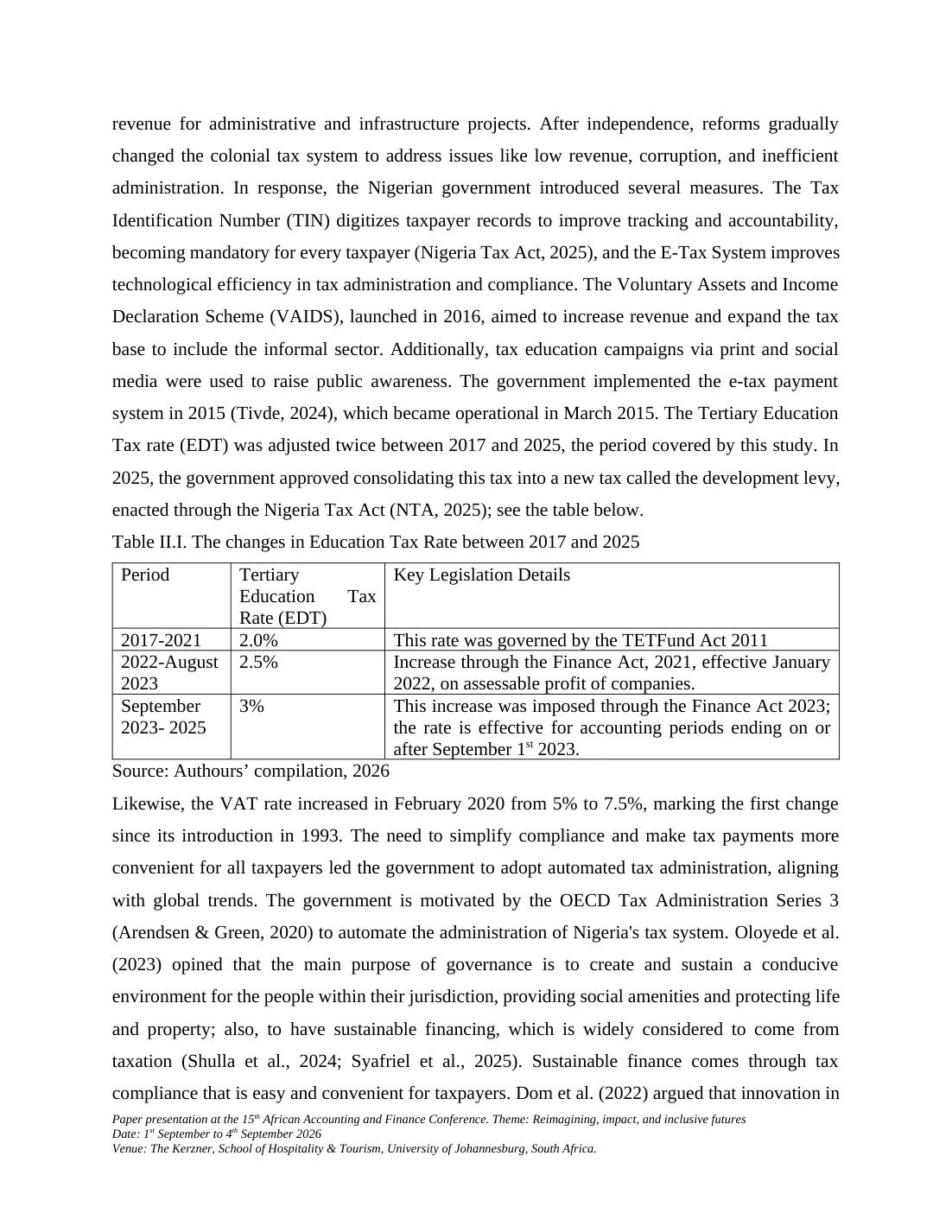
revenue for administrative and infrastructure projects. After independence, reforms gradually changed the colonial tax system to address issues like low revenue, corruption, and inefficient administration. In response, the Nigerian government introduced several measures. The Tax Identification Number (TIN) digitizes taxpayer records to improve tracking and accountability, becoming mandatory for every taxpayer (Nigeria Tax Act, 2025), and the E-Tax System improves technological efficiency in tax administration and compliance. The Voluntary Assets and Income Declaration Scheme (VAIDS), launched in 2016, aimed to increase revenue and expand the tax base to include the informal sector. Additionally, tax education campaigns via print and social media were used to raise public awareness. The government implemented the e-tax payment system in 2015 (Tivde, 2024), which became operational in March 2015. The Tertiary Education Tax rate (EDT) was adjusted twice between 2017 and 2025, the period covered by this study. In 2025, the government approved consolidating this tax into a new tax called the development levy, enacted through the Nigeria Tax Act (NTA, 2025); see the table below. Table II.I. The changes in Education Tax Rate between 2017 and 2025 Period Tertiary Key Legislation Details Education Tax Rate (EDT) 2017-2021 2.0% This rate was governed by the TETFund Act 2011 2022-August 2.5% Increase through the Finance Act, 2021, effective January 2023 2022, on assessable profit of companies. September 3% This increase was imposed through the Finance Act 2023; 2023- 2025 the rate is effective for accounting periods ending on or after September 1st 2023. Source: Authours’ compilation, 2026 Likewise, the VAT rate increased in February 2020 from 5% to 7.5%, marking the first change since its introduction in 1993. The need to simplify compliance and make tax payments more convenient for all taxpayers led the government to adopt automated tax administration, aligning with global trends. The government is motivated by the OECD Tax Administration Series 3 (Arendsen & Green, 2020) to automate the administration of Nigeria's tax system. Oloyede et al. (2023) opined that the main purpose of governance is to create and sustain a conducive environment for the people within their jurisdiction, providing social amenities and protecting life and property; also, to have sustainable financing, which is widely considered to come from taxation (Shulla et al., 2024; Syafriel et al., 2025). Sustainable finance comes through tax compliance that is easy and convenient for taxpayers. Dom et al. (2022) argued that innovation in Paper presentation at the 15th African Accounting and Finance Conference. Theme: Reimagining, impact, and inclusive futures Date: 1st September to 4th September 2026 Venue: The Kerzner, School of Hospitality & Tourism, University of Johannesburg, South Africa.
Page 5 of 19
Read page 5 as text
Refer to the original page for equations and table layout.
tax compliance should adopt information technology to reduce face-to-face interactions with tax officers, which often lead to undue delays, bribery, and other abuses. The government was advised to improve revenue through reforms involving information technology, designed to reduce the scope of evasion and avoidance. Dom et al. (2022) further noted that the focus should not always be on enforcement but rather on customer service to facilitate compliance. Governments at all levels should simplify assessments, make tax liability information easy to access, and respond promptly to taxpayer inquiries. Any reform should not focus solely on taxpayers; the customer orientation of tax administrators also requires broad attention. Oloyede et al. 2023) suggested that, to increase tax receipts, the government must transition from manual to electronic collection, as this has significantly improved the Nigerian tax system. This study is grounded in the Theory of Innovation Translation, which explores how technology is adopted and adapted to meet users’ needs. Implementation is not expected to be uniform; rather, it must be tailored to the specific environment in which it is introduced (Philip, 2012; Martin, 2022; Ottosson, 2019). Closely aligned with this perspective, Actor-Network Theory, developed by Bruno Latour, Michel Callon, and John Law in the late 1970s and early 1980s, emphasizes socio-materiality and the intricate relations among human and non-human actors that shape social realities (Fenwick & Edwards, 2010; Walsham, 1997). ANT supports the principle of innovation translation, arguing that technologies must be adapted to local contexts rather than applied in their original form (Oloyede et al., 2023). Complementing these perspectives, the Technology Acceptance Model (TAM) highlights the importance of user acceptance in the adoption of innovations. TAM posits that perceived ease of use and user-friendliness are critical factors influencing whether a technology will be embraced by its intended users (Davis, 1987). Together, these theories underscore that successful implementation of information technology requires sensitivity to user needs, contextual adaptation, and attention to usability. Oloyede et al. (2023) noted that the adoption of e-taxation in Nigeria faces challenges, including insufficient numbers of technical experts knowledgeable about the technology, skills gaps, and cybersecurity issues. Resistance to change among taxpayers was another challenge identified in the study; most especially those taxpayers who are illiterate, mostly those in the informal sector of the economy (Faniran, A., Jeje, L., Fashae, O.A., & Olusola, 2023; Ike & Bright, 2022); some still prefer the manual approach to the automated system. (Oladele et al., 2020) noted a strong Paper presentation at the 15th African Accounting and Finance Conference. Theme: Reimagining, impact, and inclusive futures Date: 1st September to 4th September 2026 Venue: The Kerzner, School of Hospitality & Tourism, University of Johannesburg, South Africa.
Page 6 of 19
Read page 6 as text
Refer to the original page for equations and table layout.
association between electronic taxation and tax compliance. Improving tax compliance means higher tax revenue. (Oladele et al., 2020) examined the revenue collected during Nigeria’s post-e- tax era (2013-2019) compared with the pre-e-tax period (2006-2012). The study employed the theory of Innovation Translation and the Technology Acceptance Model (Martin, 2022) to explain the adoption of e-tax administration by the Federal Inland Revenue Service (FIRS). The study finds a significant increase in revenue during the post-e-tax era. The study recommended improving the country's ICT infrastructure to safeguard the system against cyberattacks and disasters. (Al-Okaily, 2024) explores whether trust and awareness influence the development and forecasting of digital taxation information systems and their impact on tax compliance among academic professors in Jordan. The study employed a quantitative research method to gather data, and analysis was done using Partial Least Squares Structural Equation Modeling (PLS-SEM) to examine the collected data. The findings indicate that the adoption of digital taxation information systems is influenced by perceived usefulness, perceived ease, attitude, knowledge, and subjective norm, with a moderating role of awareness and trust. The outcome revealed that trust has a mediating association between government and digital taxation information systems. Khan et al. (2025) examine the effects of implementing electronic taxation on revenue generation and economic growth in Pakistan. In 2009, Pakistan’s tax authority adopted an innovative digital solution that included the development of mobile applications for tax registration and filing, online tax calculators, and electronic tax notices. Khan et al. (2025) analyze the adoption and implementation of e-taxation platforms such as tax filing and digital payment mechanisms by the Federal Board of Revenue (FBR) in Pakistan. The study used a quasi-experimental research design to collect data from 1996 to 2023, sourced from the Pakistan Bureau of Statistics and the FBR. For this design, the pre-post method was employed. The 28 years of data were divided into three periods: 1996-2009, 2009-2019, and 2020-2023. To analyze the data, paired t-tests and ANOVA were used. The data were categorized into the manual filing period, the internet filing period, and the period when the mobile application was introduced. The findings show that tax revenue and the GDP ratio increased after the adoption of e-taxation compared to the manual filing phase. It was further found that the mobile application period yielded the highest tax revenue and GDP ratio. Khan et al. (2025) encourage increased investment in ICT infrastructure. Paper presentation at the 15th African Accounting and Finance Conference. Theme: Reimagining, impact, and inclusive futures Date: 1st September to 4th September 2026 Venue: The Kerzner, School of Hospitality & Tourism, University of Johannesburg, South Africa.
Page 7 of 19
Read page 7 as text
Refer to the original page for equations and table layout.
Mulyani et al. (2023) evaluate the implementation of tax policies aimed at safeguarding against data breaches and fraud to protect revenue from taxes and the indirect costs of cybercrime-driven tax evasion. They adopted a normative juridical and comparative approach with a qualitative research design to address e-commerce tax issues in Indonesia. The study concluded that taxpayers involved in e-commerce are significantly influenced by tax policies affecting their compliance obligations. It recommended clear and fair taxation regulations that promote a level playing field, innovation, and compliance. Additionally, strong cybersecurity practices are included in the recommendations. Oladele et al. (2020) examined revenue collection during the pre-e-tax era and the post-e-tax payment era, spanning from 2006 to 2019. This study assessed the pre-tax payment period from 2017 to 2020 and compared it with the period when the Tax ProMax application was used for e-filing, online registration, provision of e-receipts, and Electronic Tax Clearance Certificates (e-TCCs). The era of the Tax ProMax application for this study is from 2022 to 2025, even though full implementation was launched in 2021 (FIRS, 2025). This study specifically left out the year 2021 from the post-implementation period because it was the year the Tax ProMax application software was introduced. The primary goal of this study is to analyse how e-taxation influences revenue generation in Nigeria. The specific aim is to evaluate the effect of the e-tax payment system through the Tax ProMax portal on revenue both before and after its implementation, as well as on Company Income Tax (CIT), Value-Added Tax (VAT), and the Tertiary Education Tax (EDT). The specific objectives of this study are; 1. To examine the effect of E-Taxation (E-TAX) on revenue from Company Income Tax (CIT) before and after the introduction of the Tax ProMax portal by the Federal Inland Revenue Service/Nigeria Revenue Service. 2. To assess the impact of E-Taxation (E-TAX) on revenue from Value Added Tax (VAT) before and after the introduction of the Tax ProMax portal by the Nigeria Revenue Service 3. To determine the effect of E-Taxation (E-TAX) on revenue from the Tertiary Education Tax (EDT) before and after the introduction of the Tax ProMax portal by the Nigeria Revenue Service III. METHODOLOGY Paper presentation at the 15th African Accounting and Finance Conference. Theme: Reimagining, impact, and inclusive futures Date: 1st September to 4th September 2026 Venue: The Kerzner, School of Hospitality & Tourism, University of Johannesburg, South Africa.
Page 8 of 19
Read page 8 as text
Refer to the original page for equations and table layout.
This study adopts a quantitative methodology, utilizing a quasi-experimental pre-post intervention design to assess the impact of E-Taxation on revenue generation in Nigeria. Quasi-experimental designs are particularly appropriate when causal inferences are required in contexts where policy interventions cannot be randomized (Em, 2025). The intervention under review is the nationwide implementation of the TaxPro Max digital tax administration system by the Federal Inland Revenue Service (FIRS). Given the comprehensive rollout of this system across the country, an ex- post facto evaluation approach is employed to measure its effect. The analysis leverages the temporal dimension of the policy, examining whether revenue performance demonstrates statistically significant improvement following the introduction of E-Taxation. Pre-post evaluation strategies are widely recognized in public policy and governance research as effective tools for estimating the average impact of policy interventions (Spanos, 2021; Högberg & Lindgren, 2021). The digitalization of tax administration is widely seen as a key tool for boosting compliance, preventing revenue loss, and strengthening domestic resource mobilization (Jung, 2023; OECD, 2019, 2025). In Nigeria, the Federal Inland Revenue Service (FIRS) launched TaxPro Max, an integrated digital platform aimed at modernizing tax filing, payment, and compliance processes. E-taxation systems like TaxPro Max are expected to improve revenue collection by reducing compliance costs, increasing transparency, enhancing enforcement, and allowing real-time monitoring of tax data. Evidence shows that developing economies can significantly improve revenue mobilization through digital tax systems, as long as institutional capacity is strong enough (Okunogbe & Tourek, 2024; Okunogbe & Pouliquen, 2022). Building on this research, the present study examines the impact of TaxPro Max on Nigeria’s federally managed revenue streams from 2017 to 2025. The data utilised in this study were derived from secondary sources, specifically the official quarterly bulletins of the Federal Inland Revenue Service (FIRS) and the Microtrends Global metric database. The empirical analysis is directed toward three primary revenue streams administered at the federal level, each of which has undergone digitisation through the implementation of the TaxPro Max system. Company Income Tax (CIT) – 30% tax on the primary source of corporate revenue. Value Added Tax (VAT) – a consumption-based tax contributing significantly to fiscal receipts. Tertiary Education Tax (EDT) – a specialized levy supporting educational development. These streams of revenue represent substantial components of Nigeria’s revenue base and provide a robust foundation for evaluating the effectiveness of digital tax administration reforms. Paper presentation at the 15th African Accounting and Finance Conference. Theme: Reimagining, impact, and inclusive futures Date: 1st September to 4th September 2026 Venue: The Kerzner, School of Hospitality & Tourism, University of Johannesburg, South Africa.
Page 9 of 19
Read page 9 as text
Refer to the original page for equations and table layout.
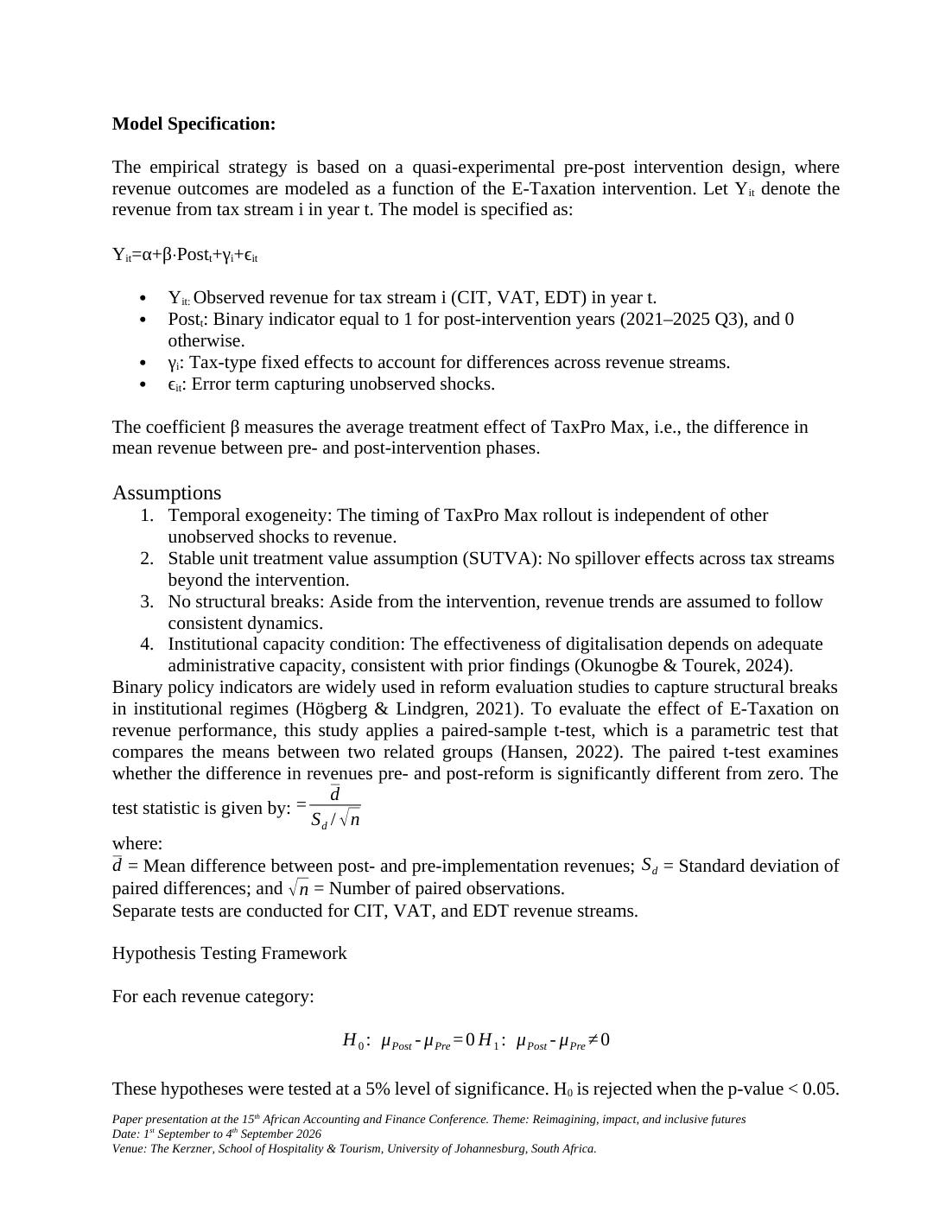
Model Specification: The empirical strategy is based on a quasi-experimental pre-post intervention design, where revenue outcomes are modeled as a function of the E-Taxation intervention. Let Yit denote the revenue from tax stream i in year t. The model is specified as: Yit=α+β⋅Postt+γi+ϵit Yit: Observed revenue for tax stream i (CIT, VAT, EDT) in year t. Postt: Binary indicator equal to 1 for post-intervention years (2021–2025 Q3), and 0 otherwise. γi: Tax-type fixed effects to account for differences across revenue streams. ϵit: Error term capturing unobserved shocks. The coefficient β measures the average treatment effect of TaxPro Max, i.e., the difference in mean revenue between pre- and post-intervention phases. Assumptions 1. Temporal exogeneity: The timing of TaxPro Max rollout is independent of other unobserved shocks to revenue. 2. Stable unit treatment value assumption (SUTVA): No spillover effects across tax streams beyond the intervention. 3. No structural breaks: Aside from the intervention, revenue trends are assumed to follow consistent dynamics. 4. Institutional capacity condition: The effectiveness of digitalisation depends on adequate administrative capacity, consistent with prior findings (Okunogbe & Tourek, 2024). Binary policy indicators are widely used in reform evaluation studies to capture structural breaks in institutional regimes (Högberg & Lindgren, 2021). To evaluate the effect of E-Taxation on revenue performance, this study applies a paired-sample t-test, which is a parametric test that compares the means between two related groups (Hansen, 2022). The paired t-test examines whether the difference in revenues pre- and post-reform is significantly different from zero. The d test statistic is given by: = Sd / √n where: d = Mean difference between post- and pre-implementation revenues; Sd = Standard deviation of paired differences; and √n = Number of paired observations. Separate tests are conducted for CIT, VAT, and EDT revenue streams. Hypothesis Testing Framework For each revenue category: H 0: μPost - μPre=0 H 1: μPost - μPre≠0 These hypotheses were tested at a 5% level of significance. H0 is rejected when the p-value < 0.05. Paper presentation at the 15th African Accounting and Finance Conference. Theme: Reimagining, impact, and inclusive futures Date: 1st September to 4th September 2026 Venue: The Kerzner, School of Hospitality & Tourism, University of Johannesburg, South Africa.
Page 10 of 19
Read page 10 as text
Refer to the original page for equations and table layout.
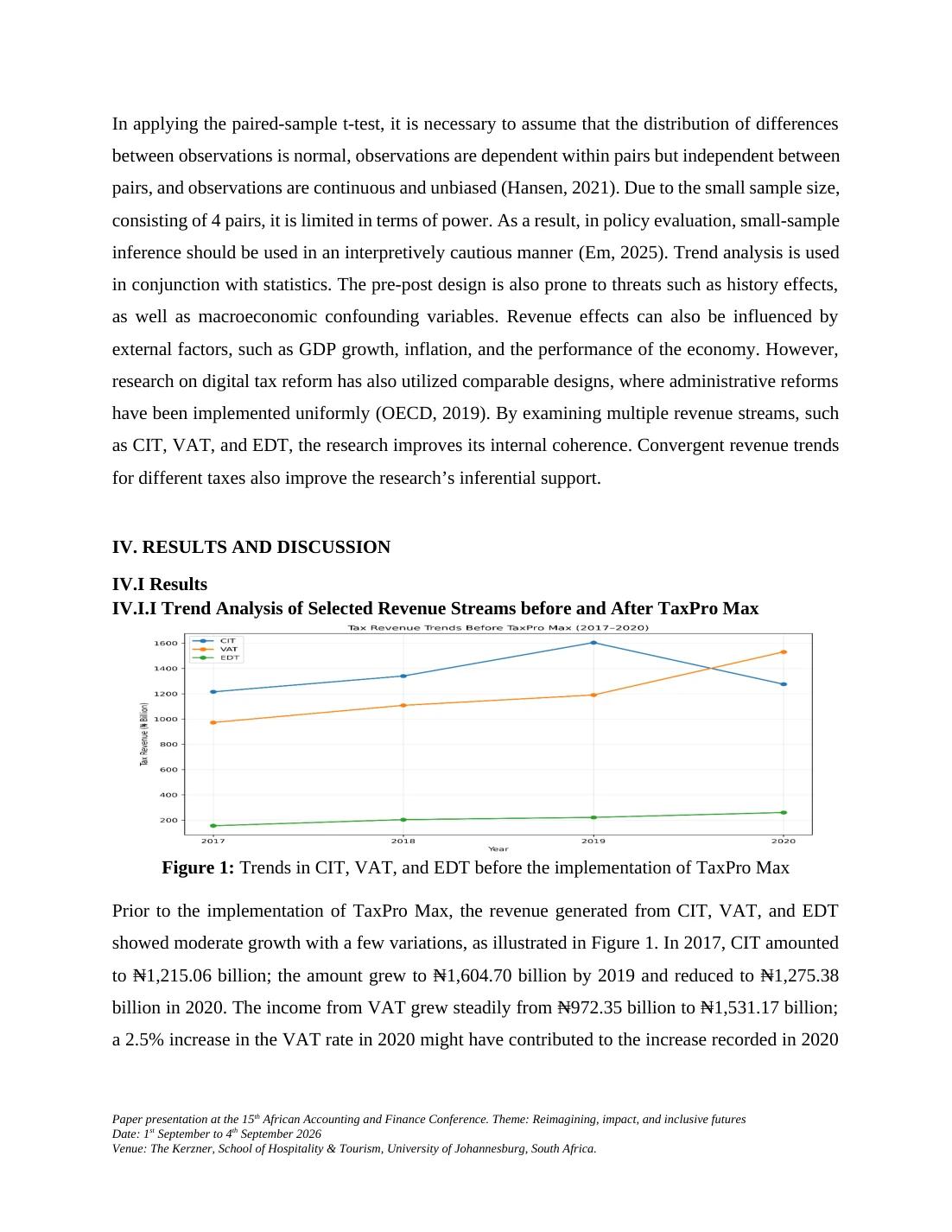
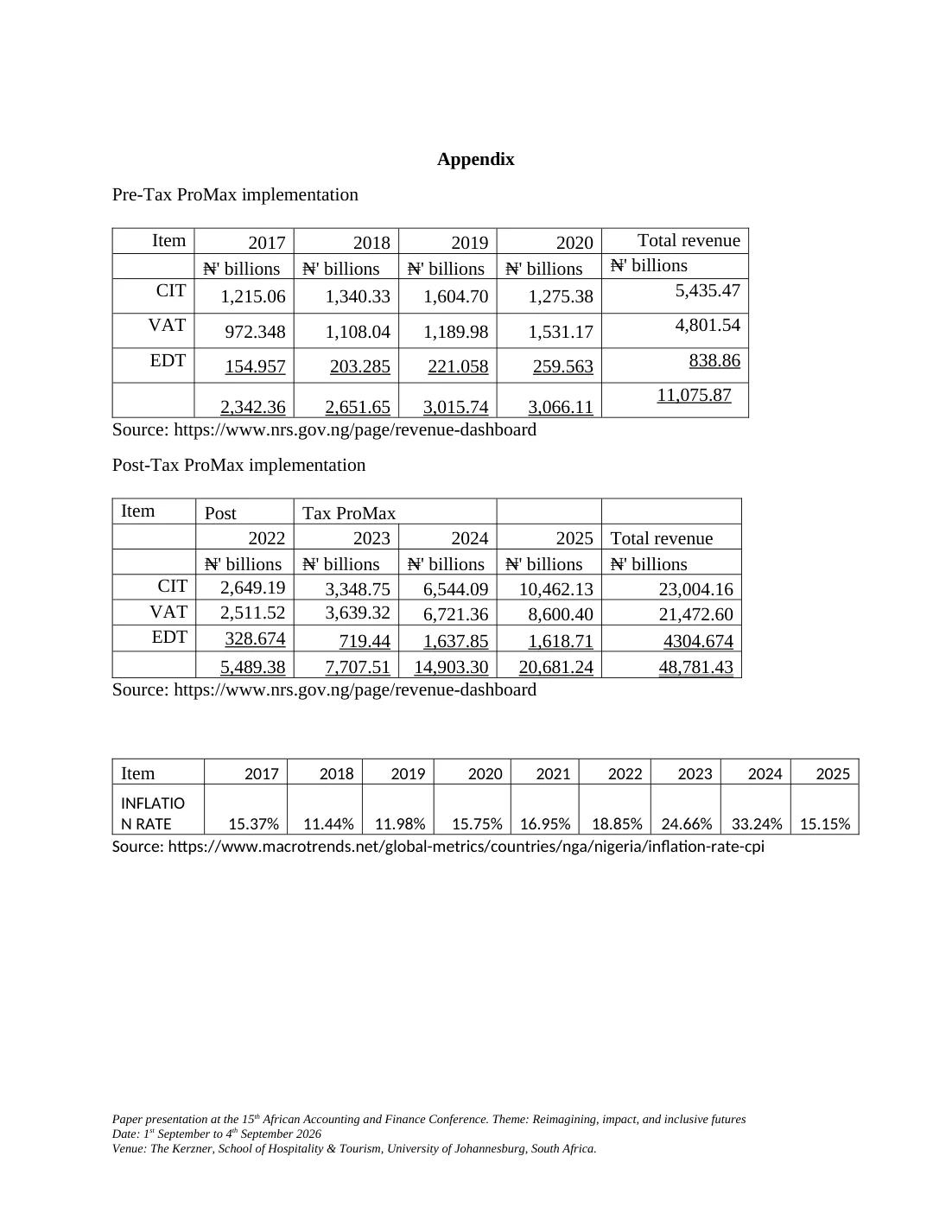
In applying the paired-sample t-test, it is necessary to assume that the distribution of differences between observations is normal, observations are dependent within pairs but independent between pairs, and observations are continuous and unbiased (Hansen, 2021). Due to the small sample size, consisting of 4 pairs, it is limited in terms of power. As a result, in policy evaluation, small-sample inference should be used in an interpretively cautious manner (Em, 2025). Trend analysis is used in conjunction with statistics. The pre-post design is also prone to threats such as history effects, as well as macroeconomic confounding variables. Revenue effects can also be influenced by external factors, such as GDP growth, inflation, and the performance of the economy. However, research on digital tax reform has also utilized comparable designs, where administrative reforms have been implemented uniformly (OECD, 2019). By examining multiple revenue streams, such as CIT, VAT, and EDT, the research improves its internal coherence. Convergent revenue trends for different taxes also improve the research’s inferential support. IV. RESULTS AND DISCUSSION IV.I Results IV.I.I Trend Analysis of Selected Revenue Streams before and After TaxPro Max Figure 1: Trends in CIT, VAT, and EDT before the implementation of TaxPro Max Prior to the implementation of TaxPro Max, the revenue generated from CIT, VAT, and EDT showed moderate growth with a few variations, as illustrated in Figure 1. In 2017, CIT amounted to ₦1,215.06 billion; the amount grew to ₦1,604.70 billion by 2019 and reduced to ₦1,275.38 billion in 2020. The income from VAT grew steadily from ₦972.35 billion to ₦1,531.17 billion; a 2.5% increase in the VAT rate in 2020 might have contributed to the increase recorded in 2020 Paper presentation at the 15th African Accounting and Finance Conference. Theme: Reimagining, impact, and inclusive futures Date: 1st September to 4th September 2026 Venue: The Kerzner, School of Hospitality & Tourism, University of Johannesburg, South Africa.
Page 11 of 19
Read page 11 as text
Refer to the original page for equations and table layout.
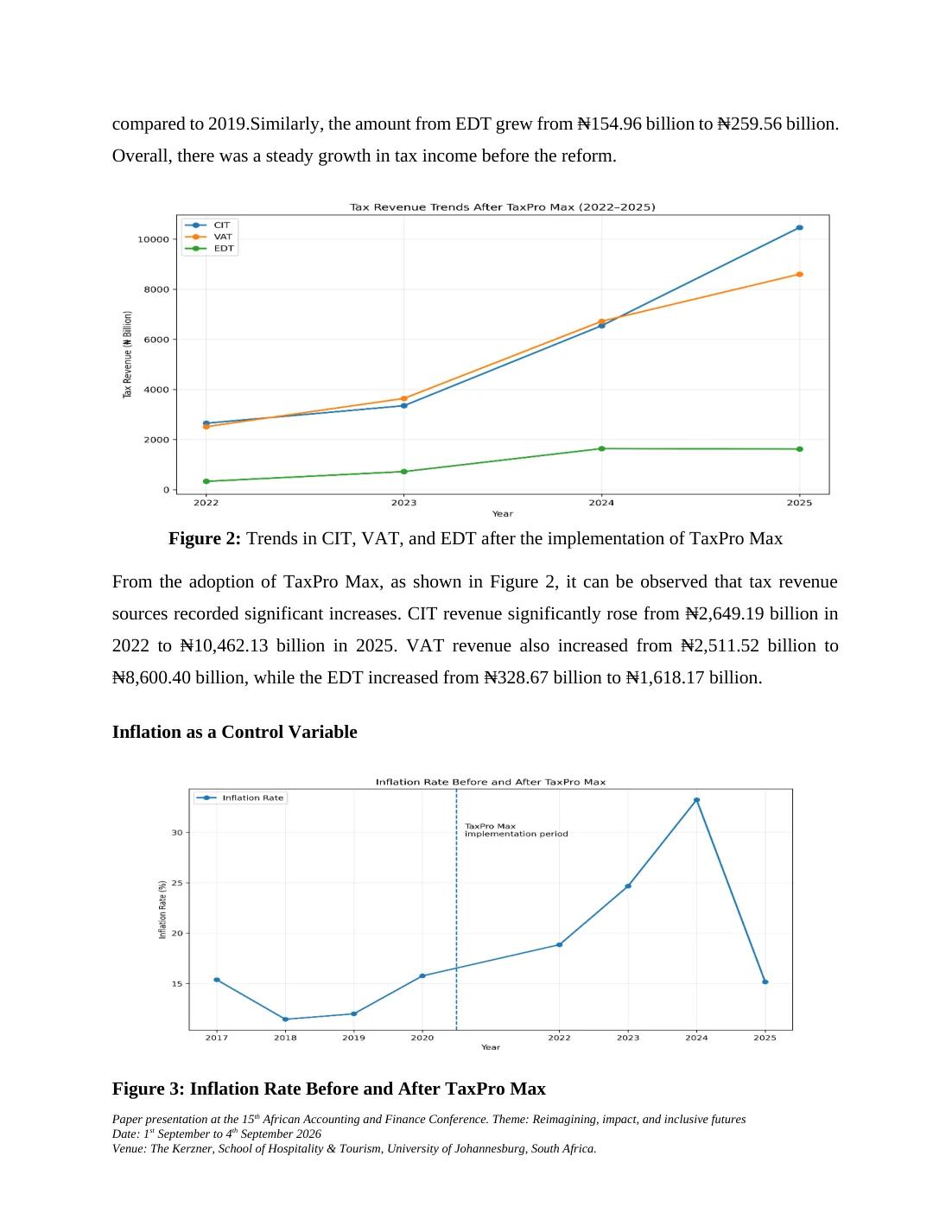
compared to 2019.Similarly, the amount from EDT grew from ₦154.96 billion to ₦259.56 billion. Overall, there was a steady growth in tax income before the reform. Figure 2: Trends in CIT, VAT, and EDT after the implementation of TaxPro Max From the adoption of TaxPro Max, as shown in Figure 2, it can be observed that tax revenue sources recorded significant increases. CIT revenue significantly rose from ₦2,649.19 billion in 2022 to ₦10,462.13 billion in 2025. VAT revenue also increased from ₦2,511.52 billion to ₦8,600.40 billion, while the EDT increased from ₦328.67 billion to ₦1,618.17 billion. Inflation as a Control Variable Figure 3: Inflation Rate Before and After TaxPro Max Paper presentation at the 15th African Accounting and Finance Conference. Theme: Reimagining, impact, and inclusive futures Date: 1st September to 4th September 2026 Venue: The Kerzner, School of Hospitality & Tourism, University of Johannesburg, South Africa.
Page 12 of 19
Read page 12 as text
Refer to the original page for equations and table layout.
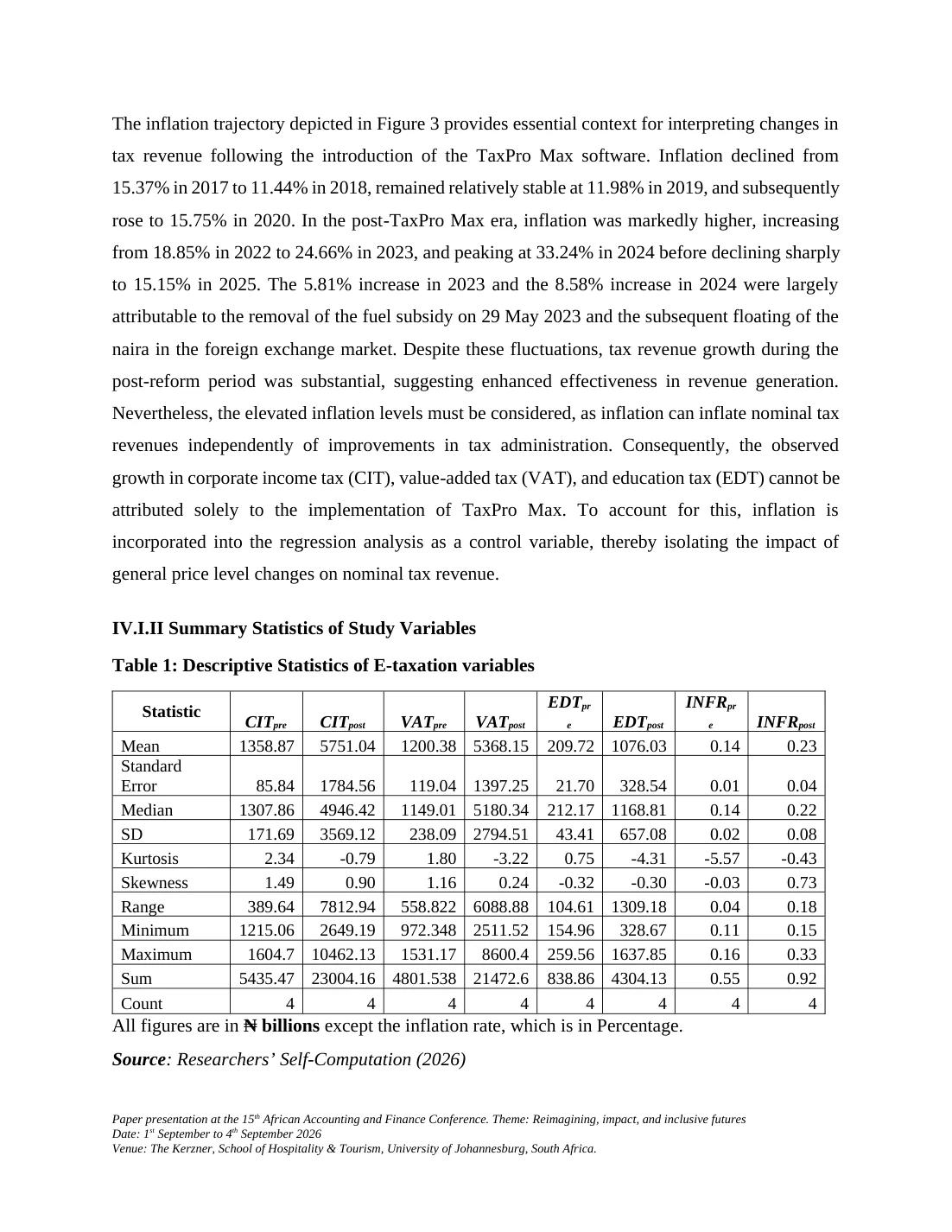
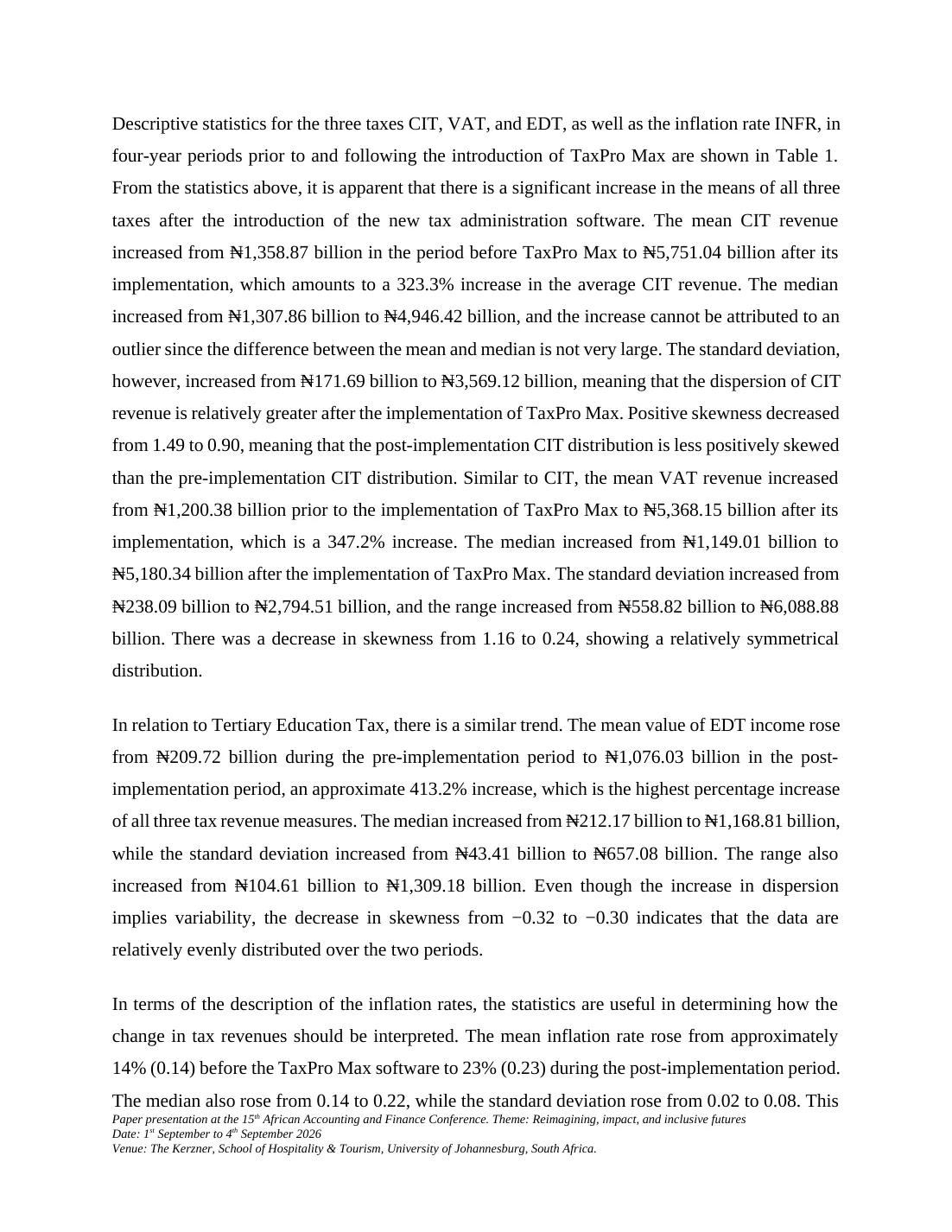
The inflation trajectory depicted in Figure 3 provides essential context for interpreting changes in tax revenue following the introduction of the TaxPro Max software. Inflation declined from 15.37% in 2017 to 11.44% in 2018, remained relatively stable at 11.98% in 2019, and subsequently rose to 15.75% in 2020. In the post‑TaxPro Max era, inflation was markedly higher, increasing from 18.85% in 2022 to 24.66% in 2023, and peaking at 33.24% in 2024 before declining sharply to 15.15% in 2025. The 5.81% increase in 2023 and the 8.58% increase in 2024 were largely attributable to the removal of the fuel subsidy on 29 May 2023 and the subsequent floating of the naira in the foreign exchange market. Despite these fluctuations, tax revenue growth during the post‑reform period was substantial, suggesting enhanced effectiveness in revenue generation. Nevertheless, the elevated inflation levels must be considered, as inflation can inflate nominal tax revenues independently of improvements in tax administration. Consequently, the observed growth in corporate income tax (CIT), value‑added tax (VAT), and education tax (EDT) cannot be attributed solely to the implementation of TaxPro Max. To account for this, inflation is incorporated into the regression analysis as a control variable, thereby isolating the impact of general price level changes on nominal tax revenue. IV.I.II Summary Statistics of Study Variables Table 1: Descriptive Statistics of E-taxation variables EDTpr INFRpr Statistic CITpre CITpost VATpre VATpost e EDTpost e INFRpost Mean 1358.87 5751.04 1200.38 5368.15 209.72 1076.03 0.14 0.23 Standard Error 85.84 1784.56 119.04 1397.25 21.70 328.54 0.01 0.04 Median 1307.86 4946.42 1149.01 5180.34 212.17 1168.81 0.14 0.22 SD 171.69 3569.12 238.09 2794.51 43.41 657.08 0.02 0.08 Kurtosis 2.34 -0.79 1.80 -3.22 0.75 -4.31 -5.57 -0.43 Skewness 1.49 0.90 1.16 0.24 -0.32 -0.30 -0.03 0.73 Range 389.64 7812.94 558.822 6088.88 104.61 1309.18 0.04 0.18 Minimum 1215.06 2649.19 972.348 2511.52 154.96 328.67 0.11 0.15 Maximum 1604.7 10462.13 1531.17 8600.4 259.56 1637.85 0.16 0.33 Sum 5435.47 23004.16 4801.538 21472.6 838.86 4304.13 0.55 0.92 Count 4 4 4 4 4 4 4 4 All figures are in ₦ billions except the inflation rate, which is in Percentage. Source: Researchers’ Self-Computation (2026) Paper presentation at the 15th African Accounting and Finance Conference. Theme: Reimagining, impact, and inclusive futures Date: 1st September to 4th September 2026 Venue: The Kerzner, School of Hospitality & Tourism, University of Johannesburg, South Africa.
Page 13 of 19
Read page 13 as text
Refer to the original page for equations and table layout.
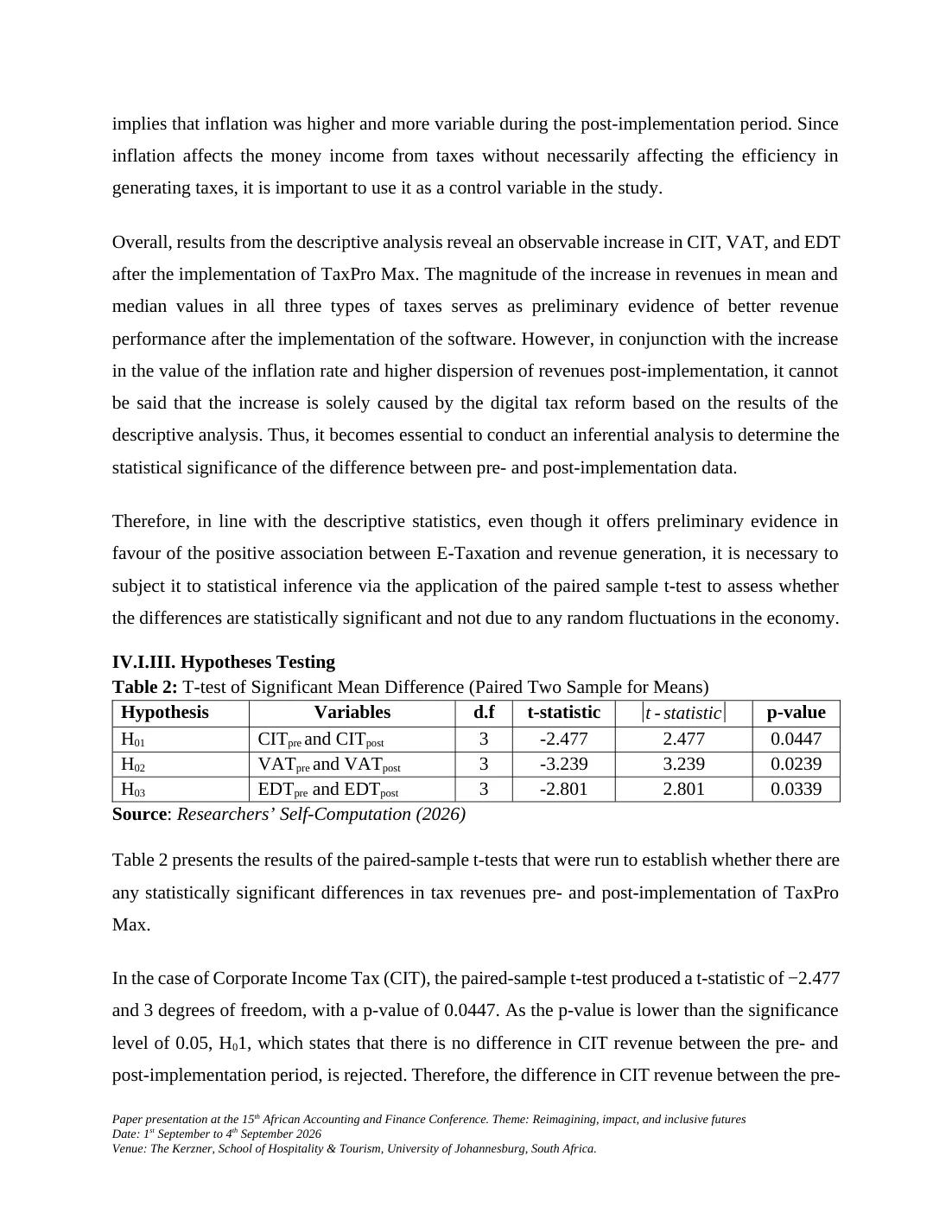
Descriptive statistics for the three taxes CIT, VAT, and EDT, as well as the inflation rate INFR, in four-year periods prior to and following the introduction of TaxPro Max are shown in Table 1. From the statistics above, it is apparent that there is a significant increase in the means of all three taxes after the introduction of the new tax administration software. The mean CIT revenue increased from ₦1,358.87 billion in the period before TaxPro Max to ₦5,751.04 billion after its implementation, which amounts to a 323.3% increase in the average CIT revenue. The median increased from ₦1,307.86 billion to ₦4,946.42 billion, and the increase cannot be attributed to an outlier since the difference between the mean and median is not very large. The standard deviation, however, increased from ₦171.69 billion to ₦3,569.12 billion, meaning that the dispersion of CIT revenue is relatively greater after the implementation of TaxPro Max. Positive skewness decreased from 1.49 to 0.90, meaning that the post-implementation CIT distribution is less positively skewed than the pre-implementation CIT distribution. Similar to CIT, the mean VAT revenue increased from ₦1,200.38 billion prior to the implementation of TaxPro Max to ₦5,368.15 billion after its implementation, which is a 347.2% increase. The median increased from ₦1,149.01 billion to ₦5,180.34 billion after the implementation of TaxPro Max. The standard deviation increased from ₦238.09 billion to ₦2,794.51 billion, and the range increased from ₦558.82 billion to ₦6,088.88 billion. There was a decrease in skewness from 1.16 to 0.24, showing a relatively symmetrical distribution. In relation to Tertiary Education Tax, there is a similar trend. The mean value of EDT income rose from ₦209.72 billion during the pre-implementation period to ₦1,076.03 billion in the post- implementation period, an approximate 413.2% increase, which is the highest percentage increase of all three tax revenue measures. The median increased from ₦212.17 billion to ₦1,168.81 billion, while the standard deviation increased from ₦43.41 billion to ₦657.08 billion. The range also increased from ₦104.61 billion to ₦1,309.18 billion. Even though the increase in dispersion implies variability, the decrease in skewness from −0.32 to −0.30 indicates that the data are relatively evenly distributed over the two periods. In terms of the description of the inflation rates, the statistics are useful in determining how the change in tax revenues should be interpreted. The mean inflation rate rose from approximately 14% (0.14) before the TaxPro Max software to 23% (0.23) during the post-implementation period. The median also rose from 0.14 to 0.22, while the standard deviation rose from 0.02 to 0.08. This Paper presentation at the 15th African Accounting and Finance Conference. Theme: Reimagining, impact, and inclusive futures Date: 1st September to 4th September 2026 Venue: The Kerzner, School of Hospitality & Tourism, University of Johannesburg, South Africa.
Page 14 of 19
Read page 14 as text
Refer to the original page for equations and table layout.
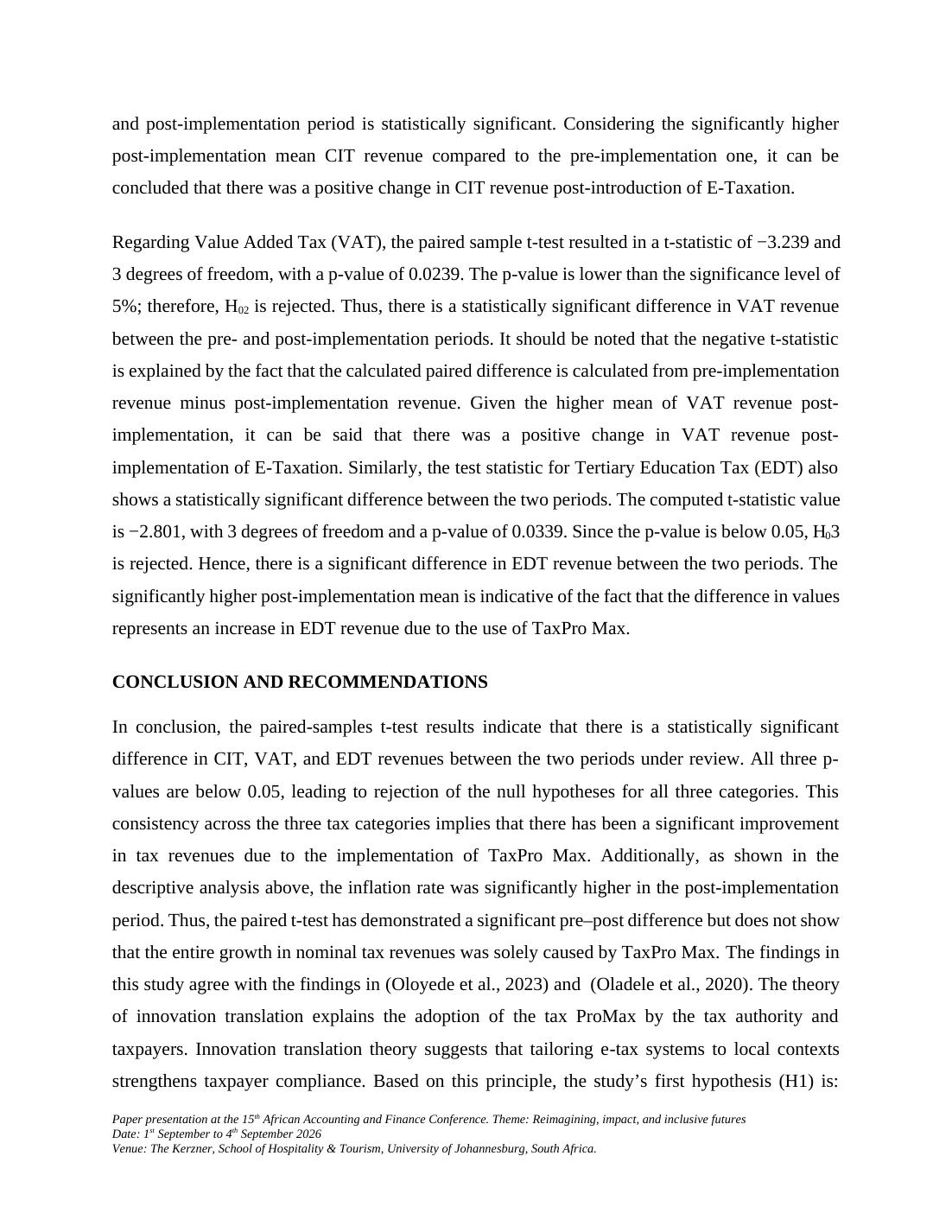
implies that inflation was higher and more variable during the post-implementation period. Since inflation affects the money income from taxes without necessarily affecting the efficiency in generating taxes, it is important to use it as a control variable in the study. Overall, results from the descriptive analysis reveal an observable increase in CIT, VAT, and EDT after the implementation of TaxPro Max. The magnitude of the increase in revenues in mean and median values in all three types of taxes serves as preliminary evidence of better revenue performance after the implementation of the software. However, in conjunction with the increase in the value of the inflation rate and higher dispersion of revenues post-implementation, it cannot be said that the increase is solely caused by the digital tax reform based on the results of the descriptive analysis. Thus, it becomes essential to conduct an inferential analysis to determine the statistical significance of the difference between pre- and post-implementation data. Therefore, in line with the descriptive statistics, even though it offers preliminary evidence in favour of the positive association between E-Taxation and revenue generation, it is necessary to subject it to statistical inference via the application of the paired sample t-test to assess whether the differences are statistically significant and not due to any random fluctuations in the economy. IV.I.III. Hypotheses Testing Table 2: T-test of Significant Mean Difference (Paired Two Sample for Means) Hypothesis Variables d.f t-statistic |t - statistic| p-value H01 CITpre and CITpost 3 -2.477 2.477 0.0447 H02 VATpre and VATpost 3 -3.239 3.239 0.0239 H03 EDTpre and EDTpost 3 -2.801 2.801 0.0339 Source: Researchers’ Self-Computation (2026) Table 2 presents the results of the paired-sample t-tests that were run to establish whether there are any statistically significant differences in tax revenues pre- and post-implementation of TaxPro Max. In the case of Corporate Income Tax (CIT), the paired-sample t-test produced a t-statistic of −2.477 and 3 degrees of freedom, with a p-value of 0.0447. As the p-value is lower than the significance level of 0.05, H01, which states that there is no difference in CIT revenue between the pre- and post-implementation period, is rejected. Therefore, the difference in CIT revenue between the pre- Paper presentation at the 15th African Accounting and Finance Conference. Theme: Reimagining, impact, and inclusive futures Date: 1st September to 4th September 2026 Venue: The Kerzner, School of Hospitality & Tourism, University of Johannesburg, South Africa.
Page 15 of 19
Read page 15 as text
Refer to the original page for equations and table layout.
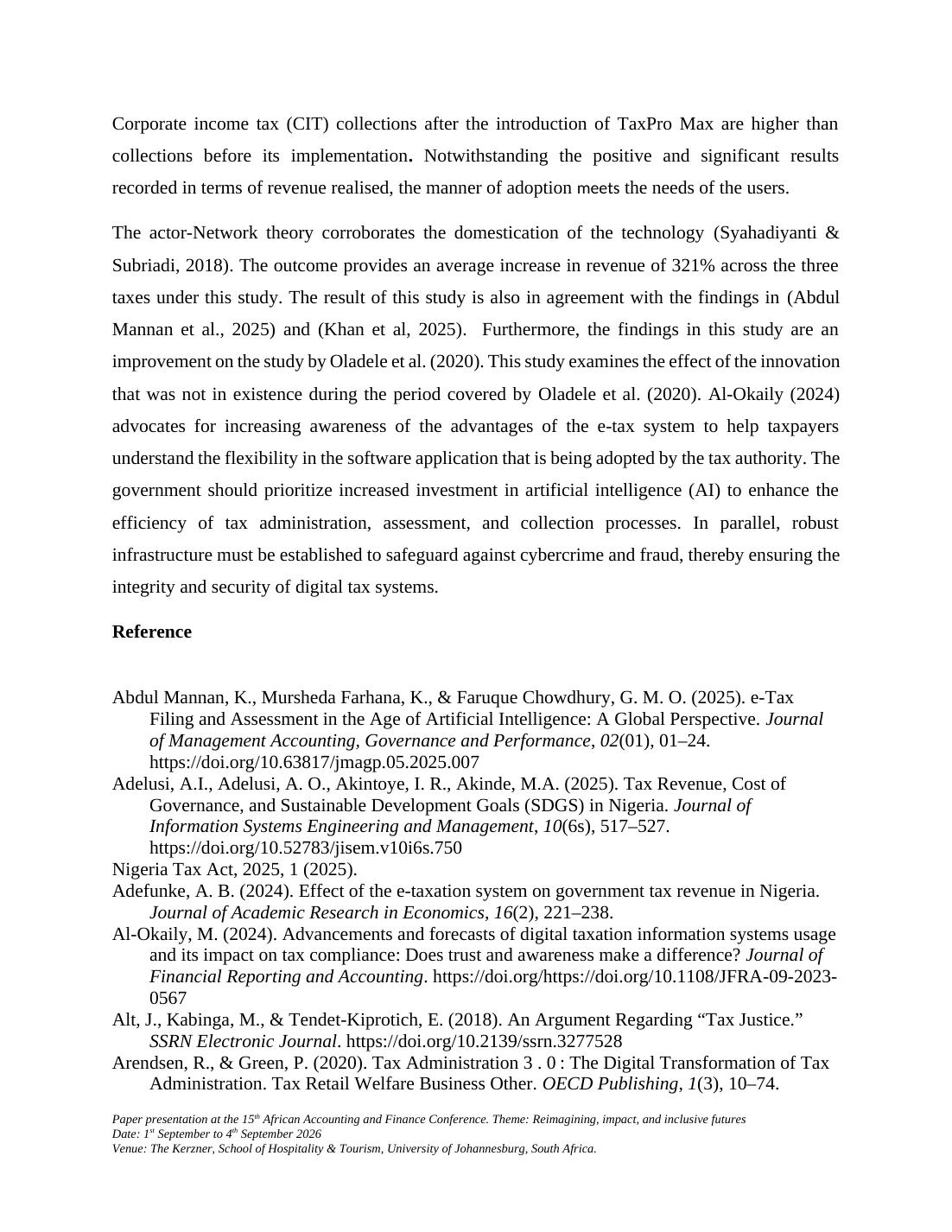
and post-implementation period is statistically significant. Considering the significantly higher post-implementation mean CIT revenue compared to the pre-implementation one, it can be concluded that there was a positive change in CIT revenue post-introduction of E-Taxation. Regarding Value Added Tax (VAT), the paired sample t-test resulted in a t-statistic of −3.239 and 3 degrees of freedom, with a p-value of 0.0239. The p-value is lower than the significance level of 5%; therefore, H02 is rejected. Thus, there is a statistically significant difference in VAT revenue between the pre- and post-implementation periods. It should be noted that the negative t-statistic is explained by the fact that the calculated paired difference is calculated from pre-implementation revenue minus post-implementation revenue. Given the higher mean of VAT revenue post- implementation, it can be said that there was a positive change in VAT revenue post- implementation of E-Taxation. Similarly, the test statistic for Tertiary Education Tax (EDT) also shows a statistically significant difference between the two periods. The computed t-statistic value is −2.801, with 3 degrees of freedom and a p-value of 0.0339. Since the p-value is below 0.05, H03 is rejected. Hence, there is a significant difference in EDT revenue between the two periods. The significantly higher post-implementation mean is indicative of the fact that the difference in values represents an increase in EDT revenue due to the use of TaxPro Max. CONCLUSION AND RECOMMENDATIONS In conclusion, the paired-samples t-test results indicate that there is a statistically significant difference in CIT, VAT, and EDT revenues between the two periods under review. All three p- values are below 0.05, leading to rejection of the null hypotheses for all three categories. This consistency across the three tax categories implies that there has been a significant improvement in tax revenues due to the implementation of TaxPro Max. Additionally, as shown in the descriptive analysis above, the inflation rate was significantly higher in the post-implementation period. Thus, the paired t-test has demonstrated a significant pre–post difference but does not show that the entire growth in nominal tax revenues was solely caused by TaxPro Max. The findings in this study agree with the findings in (Oloyede et al., 2023) and (Oladele et al., 2020). The theory of innovation translation explains the adoption of the tax ProMax by the tax authority and taxpayers. Innovation translation theory suggests that tailoring e‑tax systems to local contexts strengthens taxpayer compliance. Based on this principle, the study’s first hypothesis (H1) is: Paper presentation at the 15th African Accounting and Finance Conference. Theme: Reimagining, impact, and inclusive futures Date: 1st September to 4th September 2026 Venue: The Kerzner, School of Hospitality & Tourism, University of Johannesburg, South Africa.
Page 16 of 19
Read page 16 as text
Refer to the original page for equations and table layout.
Corporate income tax (CIT) collections after the introduction of TaxPro Max are higher than collections before its implementation. Notwithstanding the positive and significant results recorded in terms of revenue realised, the manner of adoption meets the needs of the users. The actor-Network theory corroborates the domestication of the technology (Syahadiyanti & Subriadi, 2018). The outcome provides an average increase in revenue of 321% across the three taxes under this study. The result of this study is also in agreement with the findings in (Abdul Mannan et al., 2025) and (Khan et al, 2025). Furthermore, the findings in this study are an improvement on the study by Oladele et al. (2020). This study examines the effect of the innovation that was not in existence during the period covered by Oladele et al. (2020). Al-Okaily (2024) advocates for increasing awareness of the advantages of the e-tax system to help taxpayers understand the flexibility in the software application that is being adopted by the tax authority. The government should prioritize increased investment in artificial intelligence (AI) to enhance the efficiency of tax administration, assessment, and collection processes. In parallel, robust infrastructure must be established to safeguard against cybercrime and fraud, thereby ensuring the integrity and security of digital tax systems. Reference Abdul Mannan, K., Mursheda Farhana, K., & Faruque Chowdhury, G. M. O. (2025). e-Tax Filing and Assessment in the Age of Artificial Intelligence: A Global Perspective. Journal of Management Accounting, Governance and Performance, 02(01), 01–24. https://doi.org/10.63817/jmagp.05.2025.007 Adelusi, A.I., Adelusi, A. O., Akintoye, I. R., Akinde, M.A. (2025). Tax Revenue, Cost of Governance, and Sustainable Development Goals (SDGS) in Nigeria. Journal of Information Systems Engineering and Management, 10(6s), 517–527. https://doi.org/10.52783/jisem.v10i6s.750 Nigeria Tax Act, 2025, 1 (2025). Adefunke, A. B. (2024). Effect of the e-taxation system on government tax revenue in Nigeria. Journal of Academic Research in Economics, 16(2), 221–238. Al-Okaily, M. (2024). Advancements and forecasts of digital taxation information systems usage and its impact on tax compliance: Does trust and awareness make a difference? Journal of Financial Reporting and Accounting. https://doi.org/https://doi.org/10.1108/JFRA-09-2023- 0567 Alt, J., Kabinga, M., & Tendet-Kiprotich, E. (2018). An Argument Regarding “Tax Justice.” SSRN Electronic Journal. https://doi.org/10.2139/ssrn.3277528 Arendsen, R., & Green, P. (2020). Tax Administration 3 . 0 : The Digital Transformation of Tax Administration. Tax Retail Welfare Business Other. OECD Publishing, 1(3), 10–74. Paper presentation at the 15th African Accounting and Finance Conference. Theme: Reimagining, impact, and inclusive futures Date: 1st September to 4th September 2026 Venue: The Kerzner, School of Hospitality & Tourism, University of Johannesburg, South Africa.
Page 17 of 19
Read page 17 as text
Refer to the original page for equations and table layout.
https://www.oecd.org/en/publications/tax-administration-3-0-the-digital-transformation-of- tax-administration_ca274cc5-en.html Dom, R., Custers, A., Davenport, S., & Prichard, W. (2022). Innovations in Tax Compliance. Innovations in Tax Compliance, October. https://doi.org/10.1596/978-1-4648-1755-7 Oloyede, E.F., Osundina, O., & Odewusi, O. (2023). The Impact of E-Governance on Tax Revenue Generation in Nigeria. International Journal of Humanities, Literature and Art Research, 2(1), 33–40. https://doi.org/https://mediterraneanpublications.com/mejhlar/article/view/260 Em, S. (2025). Exploring experimental research: Methodologies, designs, and applications across disciplines. Cambodian Journal of Educational and Social Sciences (CJESS), 2(2), 1–8. https://doi.org/10.69496/cjess.v2i2.78 Faniran, A., Jeje, L., Fashae, O.A., Olusola, A. O. (2023). Landscapes and Landforms of Nigeria (O. A. F. and A. O. Adetoye Faniran, Lawrence Jeje (ed.)). Springer. https://doi.org/• 10.1007/978-3-031-17972-3 FIRS. (2025). e-tax and FIRS (p. 1). Federal Inland Revenue Service. www.taxpromax.firs.gov.ng Philip D. R. G. J. S. (jamie. speirs06@imperial. ac. uk. (2012). Innovation Theory : A review of the literature (Ref: ICEPT/WP/2012/011; Issue May). Hansen, B. E. (2021). Econometrics. Högberg, B., & Lindgren, J. (2021). Outcome-based accountability regimes in OECD countries: a global policy model? Comparative Education, 57(3), 301–321. https://doi.org/10.1080/03050068.2020.1849614 Ike, E. R., & Bright, A. O. (2022). Annual International Academic Conference on Accounting and Finance Disruptive Technology: Accounting Practices, Financial and Sustainability Reporting. Proceedings of the 7th Annual International Academic Conference on Accounting and Finance Disruptive Technology: Accounting Practices, Financial and Sustainability Reporting, 2016, 20. https://doi.org/• Inc, A. G. (2021). FIRS Introduces New Online Tax Administration Solution (pp. 1–2). Andersen Tax LLC and Andersen Nigeria Limited. https://ng.andersen.com/firs-introduces-new- online-tax-administration-solution/ Jung, I. (2023). Nigeria’s Tax Revenue Mobilization: Lessons from Successful Revenue Reform Episodes. Selected Issues Papers, 2023(019), 1. https://doi.org/10.5089/9798400234989.018 Kamil, I. (2022). Influence of Artificial Intelligence Technology For E-filling and Digital Service Tax (DST) in Tax Administration on Tax Compliance. International Journal of Management Studies and Social Science Research, 4(1), 144–156. https://ijmsssr.org/paper/IJMSSSR00616.pdf Khan, M.A., Ullah, K., Khattak, A.A., Akhter, M., & Haider, A. (2025). The effect of e-taxation on revenue generation in Pakistan. Journal of Political Stability Archive, 3(1), 436–458. https://journalpsa.com/index.php/JPSA/about%0ARecognized Martin, T. (2022). A Literature Review on The Technology Acceptance Model. International Journal of Academic Research in Business & Social Sciences, 12(11), 2688–2713. https://doi.org/10.6007/IJARBSS/ Nigeria Revenue Service (Establishment)Act, 1 (2025). https://www.city.kawasaki.jp/500/page/0000174493.html Odunayo Adewunmi Adelekan, Olawale Adisa, Bamidele Segun Ilugbusi, Ogugua Chimezie Paper presentation at the 15th African Accounting and Finance Conference. Theme: Reimagining, impact, and inclusive futures Date: 1st September to 4th September 2026 Venue: The Kerzner, School of Hospitality & Tourism, University of Johannesburg, South Africa.
Page 18 of 19
Read page 18 as text
Refer to the original page for equations and table layout.
Obi, Kehinde Feranmi Awonuga, Onyeka Franca Asuzu, & Ndubuisi Leonard Ndubuisi. (2024). Evolving Tax Compliance in the Digital Era: A Comparative Analysis of AI-Driven Models and Blockchain Technology in U.S. Tax Administration. Computer Science & IT Research Journal, 5(2), 311–335. https://doi.org/10.51594/csitrj.v5i2.759 OECD. (2019). Tax Administration 2019. OECD Publishing, Paris. https://read.oecd- ilibrary.org/taxation/tax-administration-2019_74d162b6-en#page3 OECD. (2025). Tax Administration 2025. OECD Publishing, Paris. https://www.oecd.org/en/publications/tax-administration-2025_cc015ce8-en.html Okunogbe, O., & Pouliquen, V. (2022). Technology, Taxation, and Corruption: Evidence from the Introduction of Electronic Tax Filing. American Economic Journal: Economic Policy, 14(1), 341–372. https://doi.org/10.1257/pol.20200123 Okunogbe, O., & Tourek, G. (2024). How Can Lower-Income Countries Collect More Taxes? The Role of Technology, Tax Agents, and Politics. Journal of Economic Perspectives, 38(1), 81–106. https://doi.org/10.1257/jep.38.1.81 Oladele, R., Aribaba, F. O., Adekunle, A. R., & Babatunde, A. D. (2020). E-tax administration and tax compliance among corporate taxpayers in Nigeria. Accounting & Taxation Review, 4(3), 93–101. Organização das Nações Unidas. (2023). The Sustainable Development Goals Report 2023: Special edition- Towards a Rescue Plan for People and Planet. In The Sustainable Development Goals Report 2023: Special Edition (pp. 16–19). chrome-extension://efaidnbmnnnibpcajpcglclefindmkaj/https://unstats.un.org/sdgs/report/ 2023/The-Sustainable-Development-Goals-Report-2023.pdf Ottosson, S. (2019). Innovation Theory. In S. Ottosson (Ed.), Developing and Managing Innovation in a Fast Changing and Complex World (pp. 11–39). Springer International Publishing AG, part of Springer Nature, 2019. https://doi.org/https://doi.org/10.1007/978-3- 319-94045-8_2 Shulla, K., Voigt, B. F., Lardjane, S., Fischer, K., Kędzierski, P., Scandone, G., & Süße, T. (2024). People-environment relations following COVID-19 pandemic lifestyle restrictions: a multinational, exploratory analysis of intended biophilic design changes. Discover Sustainability, 5(1). https://doi.org/10.1007/s43621-024-00423-y Syafriel, M., Roziq, M., & Taufiq, M. (2025). Core-Tax System Implementation and Tax Revenue in Indonesia and OECD Countries: A Systematic Literature Review. International Journal of Current Science Research and Review, 08(11), 5426–5434. https://doi.org/10.47191/ijcsrr/v8-i11-04 Syahadiyanti, L., & Subriadi, A. P. (2018). Diffusion of Innovation Theory Utilization Online Financial Transaction : Literature Review. International Journal of Economics and Financial Issues, 8(3), 219–226. Tivde, J. K. (2024). Leveraging E-Taxation for enhanced revenue generation in Nigeria. International Journal of Research and Innovation in Social Science (IJRISS), III(IX), 661– 670. https://doi.org/https://dx.doi.org/10.47772/IJRISS.2024.809059 UN. (2024). (United Nations). The Sustainable Development Goals Report. The Companion to Development Studies, 253–257. Paper presentation at the 15th African Accounting and Finance Conference. Theme: Reimagining, impact, and inclusive futures Date: 1st September to 4th September 2026 Venue: The Kerzner, School of Hospitality & Tourism, University of Johannesburg, South Africa.
Page 19 of 19
Read page 19 as text
Refer to the original page for equations and table layout.
Appendix Pre-Tax ProMax implementation Item 2017 2018 2019 2020 Total revenue ₦' billions ₦' billions ₦' billions ₦' billions ₦' billions CIT 5,435.47 1,215.06 1,340.33 1,604.70 1,275.38 VAT 4,801.54 972.348 1,108.04 1,189.98 1,531.17 EDT 838.86 154.957 203.285 221.058 259.563 11,075.87 2,342.36 2,651.65 3,015.74 3,066.11 Source: https://www.nrs.gov.ng/page/revenue-dashboard Post-Tax ProMax implementation Item Post Tax ProMax 2022 2023 2024 2025 Total revenue ₦' billions ₦' billions ₦' billions ₦' billions ₦' billions CIT 2,649.19 3,348.75 6,544.09 10,462.13 23,004.16 VAT 2,511.52 3,639.32 6,721.36 8,600.40 21,472.60 EDT 328.674 719.44 1,637.85 1,618.71 4304.674 5,489.38 7,707.51 14,903.30 20,681.24 48,781.43 Source: https://www.nrs.gov.ng/page/revenue-dashboard Item 2017 2018 2019 2020 2021 2022 2023 2024 2025 INFLATIO N RATE 15.37% 11.44% 11.98% 15.75% 16.95% 18.85% 24.66% 33.24% 15.15% Source: https://www.macrotrends.net/global-metrics/countries/nga/nigeria/inflation-rate-cpi Paper presentation at the 15th African Accounting and Finance Conference. Theme: Reimagining, impact, and inclusive futures Date: 1st September to 4th September 2026 Venue: The Kerzner, School of Hospitality & Tourism, University of Johannesburg, South Africa.
READER CONVERSATION
What did you think?
Choose a reaction or join the discussion.
Connecting to the discussion…
One reaction per browser. Select it again to remove it.